I put some ideas into the world this week and got robust feedback. I made breaking changes to a library I own and then immediately started planning my next revisions. I watched Hamilton, again, and got feelings, again, but some new ones and I know y’all love to hear about my feelings so you better believe I’m going to talk about them.
Continue readingAuthor Archives: Jonathan
S09E14: A weird grab bag of feelings
So last Sunday I saw the most recent (I can’t say latest, it’s been out for so long you can download it legally now) Spider-Man, and something made sense. A few days before, my partner and I were at a station watching a little cluster of teenage men cracking each others backs. The process is that you cross your arms over your chest, fist to opposite shoulder, and your friend stands behind you, grips you at the wrists, and lifts you up. You can feel your vertebrae popping and it makes a fantastic noise.
In Spider-Man – spoilers ahead – one of the spiders-man does it to one of the others. Web-swinging is apparently murder on your middle back. And I was suddenly reminded of these boys, and also of this work by Barbara Kruger, which is burned into my brain:
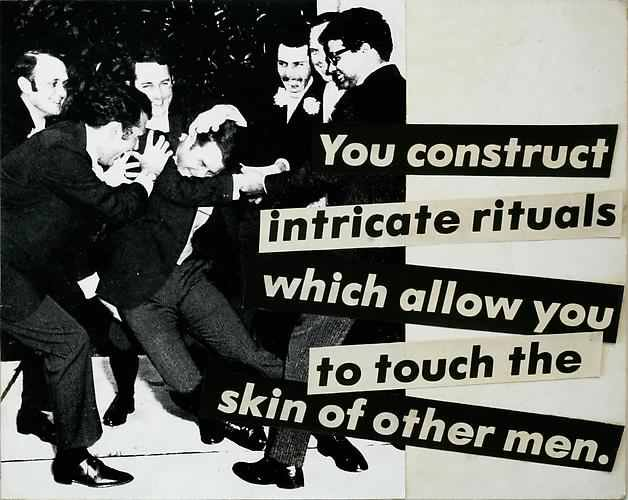
Because it’s true, isn’t it lads? We don’t want to give each other a hug, but you’d crack a back for your bro. Because it’s about proving you’re strong, right, and doing a favour, and not at all about comfort and pressure and feeling held and feeling not alone.
And I just – I enjoyed it. I liked seeing guys looking out for each other and being brotherly in a movie that is marketed as a nice, fun, non-dramatic movie.
It’s nice to see boys just being boys.
Did you know that in scientific papers the scientific authors will scientifically enumerate the number of mice that they’ve ‘sacrificed’?
It’s a weird word to use for a scientist, I think. I think this in part because I was brought up very Christian and so the word ‘sacrifice’ has, hum, had meaning for me for a long time. The first story in the Bible is about sacrifice, and how God was not hugely pleased with the selection of vegetables that Cain offered up.
I think in modern parlance ‘sacrifice’ has come to mean ‘prioritise’, and I don’t like it, and I especially don’t like it in the context of relationships. Let me tell you how I define a sacrifice, coming as a I do from a Christian background, and then you can either explore other words we could use or ignore my definition entirely.
A sacrifice is a gift, freely given, in the hope that you will in future receive something greater in return but accept you may also not receive anything at all. It is therefore completely necessary to a relationship with God, and fundamentally unsound for a relationship with a person. For what it’s worth, I think the scientists are using this definition: every scientific endeavour is a sacrifice of time and money and sometimes lives in the hope that what will be returned will be worth more.
(Your understanding of ‘worth’ might differ from those scientists, and perhaps your definition is the one we should accept and behave as if it were correct, but for now let’s accept that folks have different meanings for this stuff)
God and I have long since parted ways, though we are still on nodding terms, so let’s talk about this definition of sacrifice in the context of human relationships. There is this phrase, “I sacrificed (thing) for you.” In my experience it does not usually mean that they burned (thing) at an altar with the appropriate prayers and rituals. What they mean is that they prioritised you over (thing), and they feel you should have:
- noticed and reciprocated by sacrificing (other_thing) of equal value, or
- given you the return you thought you were due, or
- told them to prioritise (thing) over you
I firmly believe that this phrase is indicative of a transactional view of relationships (gross) and also cowardice. If you sacrifice a thing and then get mad about it, what you actually wanted was an exchange. Built into the idea of a sacrifice is that sometimes you get nothing. Sometimes you get nothing because what you’ve received is a lack-of-bad-things; that is, through the sacrifice you have avoided a piano falling on your head or avoiding a terrible disease.
Sometimes what you get for your sacrifice is the knowledge that God is “doing keto right now, yeah?”.
So sacrificing something and then becoming resentful that you’ve not received your just reward is such, such a clear sign to me that you don’t know what a sacrifice is. What you’re thinking about is a trade, and love is not governed by the Law of Equivalent Exchange.
What then of cowardice? Cowardice is the outsourcing of your choices to someone else. If you prioritised your partner and their wants and needs over yourself, then that is your decision to own. Why do you now resent them? Is it because, unbeknownst to them, you were not prioritising them: you were sacrificing something, in the full expectation that you would reap its rewards? That’s not a choice, that’s treating your partner like a piggy bank that you can smash open later.
Transactions happen in a relationship, and so do compromises: I make the dinner tonight and you wash the dishes; I will get over my thing about poop and you will accept that my nappy-wrapping won’t be as neat. We are human beings and we can make these exchanges. You can talk to your partner about what you want to trade and compromise on, as long as you can accept that you’re not always going to get your way.
But your partner is not God, nor a force beyond human ken.
They cannot know the sacrifices you make in secret, and they cannot uphold the sacrifices you declare. They can only be themselves. You have to choose, and if you choose wrong you can only choose again.
If you keep prioritising your partner’s wants and needs over your own and they also prioritise their own wants and needs over yours then, friend, talk to me please because I’m not convinced that’s a healthy dynamic.
And none of this, mind you, is to say that there are no sacrifices in a relationship. But I firmly believe that if you make a sacrifice for the sake of the relationship then it should be in the hope that it will be good for the relationship, which is this weird messy complicated thunderstorm of your wants and their wants and your potential future wants and what you imagine they will want, and so on. Bluntly, I would expect a sacrifice to be in the pursuit of some benefit to everyone in the relationship.
This piece still isn’t where I want it to be. I think there’s some wooly thinking here. But we’re getting there.
Let’s have a good weekend all.
S09E13: Scala, conflict, and grasping for control
I realised something this week while doom-scrolling Twitter, browsing Zoopla, and applying for jobs that I don’t really want.
When the world around me doesn’t make sense and seems more chaotic that usual, I try to exert control on it. I can only control my life, and I get the urge to wrench it around to prove that I still can. I’ve walked out of jobs before to prove that I could still control my own actions. To prove to whom? There’s a question.
Continue readingS09E12: It’s been a week, hasn’t it
This week has been intense. I feel like I’ve progressed a lot of work, but against the backdrop of world events, it all feels quite small. I think the trick is to focus on the small as a reflection of the large. I can help some people here, as much as I can, in the ways that I can. It’s not enough, but maybe it’s a start.
Continue readingS09E11: Bittersweet
Just one topic this week. I need to talk about this, and it’s difficult for a few reasons, so I’ve not got energy for anything else. I am coming up against the first real professional failure of my career, and it’s hitting me really hard. Worse than that, I’m trying to work out how to talk about it without causing hurt. Please forgive me if, despite my best intentions, you’re hurt anyway.
Continue readingS09E10: Decision time
But first, the news.
Continue readingS09E09: Baby steps
The world turns, and what was dead is come alive, and the seawater in our blood sings a siren song
February is upon us, my loves, and spring lurks around the corner like a clown. What shall we talk about this week?
I’ve kicked off a piece of work with a crack team of colleagues to sort out another business case. I have two simmering away at the moment, and both are on generally the same theme: we need a big thing funded. The thing is big and and its value is therefore diffuse. Who then should pay for it? End users, or the people who pay for the end users, are reluctant to pay for it because they don’t really see the benefits.
But maybe the value of a big thing is sometimes that it’s a big thing. Sometimes a flag is more than a piece of cloth. Sometimes a glance is more than a chance of eye contact. Sometimes a nation is more than a shape traced on a map.
It’s a real struggle, so if anyone’s knows some exciting new ways of calculating value for business cases that’s not solely based on pennies spent or unspent but human connections made and problems averted – wave at me.
More small steps, this time in the direction of the service I’m building for the CS LGBT+ network. There have been quite significant changes since the last time I wrote to you, though none of them are obvious from the interface. This is – god, I know I say this every time, but that’s the joy of getting older and learning from the brilliant people around you, it’s always true – this is the best work I’ve ever done. It’s still not perfect. There are plenty of things I need to improve. Nonetheless I know what I’m doing, and what needs to be done next.
For example, here’s a tiny little feature, laid out sensibly with an approach. It’s not a giant plan with deadlines and so on, but it’s evidence that I can look at a feature and break it down and then engage with each step. Which is tiny stuff compared to my day job, but also the best way I can find of maintaining my enthusiasm and prove I’m still okay at writing code. Setting aside software to get into management is approximately as hard as giving up heroin, and it’s much harder on your pocket. With the same reasoning I’ve broken up a workout plan into two sessions a week and put them on our kanban at home. Small tasks that are easily achieved, or sometimes sweating like a warm cheese, gives me an enormous sense of wellbeing. Parklife.
In two weeks time I will be halfway through my loan. I’ve been applying to things again, to get a sense of what’s out there and also to get some feedback on where my experience pitches me. So far I’ve had:
- a final interview for a role with an org that I’m dying to get, so I’m doing my best not to glance too hard at that particular hope in case it crumbles under the weight of my hopes
- an approach from Palantir, which was flattering but also deeply disturbing, like your worst enemy telling you they admire you or your schoolmates declaring you most like to be a successful serial killer
- An approach from various recruiters to do contracting, which – now that I’ve seen what we pay contractors – frankly looks deeply appealing
- three applications which fell at the first hurdle. They were for the same grade as the first in the list, and with each rejection the weight of my expectations on that interview further threaten to overwhelm it
- a good interview with a smart, forward-looking application where I’d be happy and stretched but nonetheless maybe not…fulfilled? More theraputic work needed there, I think.
That’s all for today friends. Take care, especially if you’ve got Covid
Immutable containers and trash-talking tags
This is gonna get geeky
Continue readingS09E08: There is no such thing as too much documentation
Last week I wrote about how I was going to pick up the work I was doing with the Civil Service LGBTQ+ network. This week I’ve spent many hours reviewing and fixing minor bugs because I didn’t write enough documentation.
I also wasted an hour of a colleague’s time because I wrote an email hastily and left out important context, which meant she did a bunch of work for me that I didn’t need and so was wasted.
So this week’s theme is how writing is important, and how a lack of documentation is actually better than bad documentation.
The way that I write is more or less. That is to say I write poetry or I write emails. Poetry is a delight, because one can write outlandish, abstract phrases like I was doorless when I met you and someone you quite fancy will find you unbelievably sexy and they can make up their own meaning, which means you can never be wrong, unless you’ve written something tremendously awful.
Abstraction and poetry are less well-suited to emails, where one must simply say I don't have a door and I would like you to install one, which admittedly may make someone who is already fond of you more attracted to you but is unlikely to spur advances from a handyman. Even if you accidentally put a xx on the end because you’re absent-minded and texting your mother at the same time.
Documenting code, particularly code that you suspect deep down will only ever be read by you, is therefore a weird place to be. There’s no feedback loop and the only person you can impact is yourself, and so frequently I don’t write enough documentation. Sooner or later this means I abandon the project, because at a certain size it’s too big to start writing documentation and it’s incomprehensible. Not this time. At the very least I know this is something someone relies on, so I’m going to do my utmost to make it better.
It also needs some kind of frontend/graphical user interface, which has not been my strength so far. So plenty of documentation there ensure I can come back to it without wanting to burn it all down and start again.
If you run a mentoring scheme, and you’re technical enough to know your way around the command line, please do try this out and let me know how you get on.
I got support this week from my senior people to run an experiment with a team in my department and GitHub Codespaces. It’s kind of new and kind of old as technology goes. GitHub offers you a virtual computer, hosted in the cloud, that’s charged by the minute. They can offer significantly more computing power than I can afford to buy, so it’s a no-brainer – why not have devs charged by the minute for an awesomely powerful computer?
The reason I say it’s kid of old is because it sort of reminds me of mainframe computing and time-sharing. Which is kind of cool – it means time is cyclical but progress is upward, so we’re all in a beautiful helix of progress.
Not a spiral. I have strong feelings about how spiral has completely taken over the meaning of its more accurate cousin helical.
In any case, with funding sorted, quantitative and qualitative data surveys standing by and the team fairly frothing at the mouth to get started, I’m really excited to kick off my first human experiment.
S09E07: Anyone else keep writing 2021?
Of course you do.
As traditional this first week is when, if you sent “Let’s pick this up in the new year!” emails, you receive “Picking this up in the new year!” emails. It is a tradition as old as the hills, as long as they are very new hills and, if one looks closely, artificial.
This week I closed off some caretaking I was doing on a small service I was made responsible for. It got me thinking about how best to actually organise this stuff in the department, so I’m now on a mission to come up with some standard ways of organising people into teams, controlling access to the stuff they work on, and then managing how that changes over time. Because it will absolutely change over time, and a system perfectly etched in glass is no use to anyone.
This feeds into some strategic thinking I’m doing around the future of my profession in my department. At the moment I’m thinking about recruitment, retention, software, hardware, and standards. Does that sound about right? What else should I be thinking of when considering the next five years of software development? Thoughts on a postcard/email/Twitter message/by pigeon (you may not get your pigeon back).
As ever the strategic work is not just thinking about the thing, but thinking about how to sell the thing to everyone else in the organisation. If I think we should go in a direction, it’s no good me storming off in that direction because for plenty of folks that’s not a direction they much care about. As a naif I expected the brilliance of my idea to stagger people. It’s good for me to come to the realisation – again – I must do it at least once every six months or so – that I am not the main character in anyone’s story but my own.
My partner and I settled on some goals for this year. My current promotion is only temporary, but I’m enjoying it so much I want to keep working at this level for the foreseeable, so by the end of this year I’d like to have secured a permanent role at my current grade.
We’d also really like to move house: either further into Eine, or somewhere else entirely. Either way we need somewhere bigger: we have a wardrobe that groans with cloaks, knitting needles, board games and the other accoutrements of the modern yuppie lifestyle. We need space for at least two wardrobes. Perhaps even three.
Finally, I want to finish off the work I started with the Civil Service LGBT+ network. I’ve built a script to improve the mentor matching process, but I want to do something with it to make it useful to folks who aren’t as technical as me.
 Caffeinated Punctuation