S14E03: At last! My arm is complete

Sometimes I get a week full of people telling me what they see, and it is very often a pleasure. That has been this week, more or less.

My old – very old! – corporate objective reared its head again. Working on a single codebase that’s closely coupled to policy has been a fascinating journey, as I’ve watched it become more and more out of date. It was, once upon a time, policy as code. The policy is different now and, knowing how slowly policy changes compared to the real world, means the code was probably out of step before the policy was changed. We might have noticed that the policy, and hence the code, needed to change when people started trying to use the system in a way it’s not designed.

I’m thinking about this a lot at the moment, actually. There’s something about writing a lot of policy and then letting it out into the world that tells me a lot about the way the world is changing, and that’s even within the microcosm of the little corner of the world I inhabit. Is it better to write a policy that describes ‘as-is’, try to change behaviour, and then inscribe that? A kind of ratchet that means we can’t go backwards (although we can, of course), and where the iterations track the maturity of the organisation?

Another mode of thinking says that policy is a behavioural change lever. We write things down and then we use that to try to push people upwards towards the bar. Then we inch the policy up again.

Both of these are kind of bad. I think both of them are bad because the POSIWID. If the system you’re trying to police – the verbal form of policy, I reckon, is police – is doing things that aren’t in the policy you’re facing the possibility of having to change the behaviour of many, many people who aren’t incentivised to change. That means the beatings have to continue until the behaviour changes, and that’s not good for anyone. That means the first approach will result in a policy that never goes anywhere, because the organisation isn’t going to change – but it also means the second approach is doomed at once because the organisation isn’t going to change!

There are lovely, easy bits of policy – sometimes. A policy that I can implement as code becomes part of the invisible nudge of the system. If it’s easier to go along with sensible security defaults, and it’s as quick as not securing things, then folks will never complain and will generally thank you. But sometimes I need folks to change the way they do something that will slow them down, and I have to sell them that this is somehow a good thing.

And if the POSIWID, and what the system does is ‘get shit done’, it’s all kinds of hard to convince them not to do that.

S14E02: what wondrous ghosts we are

This week I’ve done policy-writing and team-being-together-ing. The team getting together was excellent. I think in part it was excellent because most everyone already knew everyone else, so we didn’t need to do the work of building trust with each other before we got into the meat of what we had to discuss. That saves time. Building trust saves time when we have to move quickly, but you can’t build trust quickly. It’s an interesting little – not symmetry, exactly, but opposite? To go fast, first go slow.

Policy writing is fascinating to me. I did a whole six-minute speech on this to some colleagues. Policy is just the writing-down of the behaviour we’d like to see. Writing things down is not performative, though I think some of us policy-writers would like it to be so, and some of us believe it to be so. This is because the system focusses on getting the words right, and POSIWID.

Sorry, I’ve introduced two completely different ideas there and rudely not told you what they’re about.

Performative actions are acts where we perform something and in doing so make it reality. A nice simple one is a judge saying “You will be taken to prison,” because upon that pronunciation it actually happens. “I now pronounce you married” changes the state of the world from one in which two people were not married to one in which they are.

Judith Butler says gender is performative, and I think that’s a very interesting thing to think about.

Policy-writers can change the world from a place where an act is permitted to one where it is not permitted. But it will not change the behaviour of the people in the world, unless there are actors who will enforce it. The words will only be performative if the actions of the actors reflect that it’s true.

I’m getting quite tired of worrying about the very specific words I’m writing, and more interested in the…vibes, I guess? Of making the changes that are written in the policy. I think most people will only make change over time, and they’ll generally follow the spirit of a policy rather than its specific clauses. So the sooner I can get in front of people and say, hey. Please make these changes to how you do your job. It’s important. I know it’s a pain. I know we’re going to argue about it. Please do it anyway. Please. Please!

…the sooner it’ll actually start to happen.

The purpose of a system is what it does (POSIWID) is an acronym1. It’s well-loved in a management science called cybernetics. It argues that the purpose of a system is not defined by vision statements or well-meaning corporate values but by what the system actually does. If the tax system creates millionaires, then that is its purpose. If a social media company amplifies disinformation on behalf of foreign governments, then that is its purpose. And if an organisation argues its purpose is to ‘change the conversation’ or ‘create high performing teams’ or ‘secure investment’ and most of their work is on writing and publishing things then the purpose of the system is what it does, and all this system does is generate tyrannical editors and an obsession with ever-more-flowery language.

If the point of the system is to change behaviour then that is what we have to make the system do.

  1. A true acronym, where you say the letters as a word, as opposed to an initialism, where you say the letters (NSA, FBI). Sometimes, for fun, if someone says that a thing is an acronym when it’s an initialism, I treat it as such.

    I know I’m obnoxious. You don’t have to tell me. ↩︎

S14E01: Alright. Let’s do this one. more. time.

I’ve got a new job (perhaps there’s something in the air) and I’m doing my best to write my stupid thoughts for my stupid mental health. I’m trying to navigate what I can talk about in my new job, and what I have to keep to myself. I’ll probably be more risk averse, at least for the first little while, and err on the side of sharing less. Luckily for you, that means more nonsense, and less work stuff. Hurrah!

I found myself quite lonely this week, on a couple of really interesting axes. The first was in myself. I’ve had a couple of home-working days when all I’ve been doing is writing policy, and I’ve found it incredibly hard. No meetings meant little human contact, and I found myself spinning my wheels. This is particularly odd for me, because I can (and have) gone entire weekends without talking to anyone at all. Work, it seems, is something I can’t do in absence of others. Books on the other hand: leave me well alone, thanks.

I suspect one reason I’ve only just realised this is because for the last two years I’ve been solidly plugging away at my MSc. Right now my grade point average is 0.74, which means I’m on track for a Distinction. I’ve still got to write my thesis, and that means sitting down and actually figuring out what the hell it is I actually want to spend 6 months on. At the moment it’s software bills of materials, but it may turn into any number of other things. I have too many damn ideas.

Coming up for breath out of that intensity has made me realise that my partner’s done the hard work of building a network in our new home, while I’ve just got more anxious about the network in our new home.1 I’ve now got to get out there and find people who do the kinds of things I like to do, which itself prompts a reflection: what are the things I like to do that aren’t work?

Oh, my friends, the brevity of that list.

It’s a joy to enjoy your work – a joy and a privilege. There is no doubt an element of autistic focus in this: I have found my special interest and have made it my entire personality and managed to get paid for it, which is a huge win. But it means that I don’t know what else I like. Still, there’s a list, and I’m going to start working through that list. Top of that list is speaking and performing. I am an absolute maniac for performance, and am nearly feral for performances about performances. I’m signing up for Toastmasters, which feels a teensy bit culty, but could be a good way to meet people who are interested in similar things to me and get an interesting qualification. There’s also a great little network of French speakers here, and I’ve found a Russian class that I could start next year.

What do you mean, “that sounds like more studying”?

Oh. Right.

  1. This is a fun little joke. The network is fine. ↩︎

S13E07: Working with others

I have a headache and I am grumpy about it. I have received a couple of incredibly shitty emails, and I’m grumpy about that. And someone whom I trusted to do some important work hasn’t done it, and I’m grumpy about that too.

Normally I’d say that I don’t know why I bother, but given that I do bother, I thought I should talk a bit about why.

Continue reading

Manchester Rental Opportunity of the Week: You’ll Take It, And You’ll Be Grateful

I’ve only done two of these columns, and one of them was the introduction. We’re only on the second actual property, and already I’m losing the will to live. I am, however, gaining a kind of icy fury, a gnawing sense of injustice, and an RSI. We are once again in Salford, where a landlord is offering the opportunity to rent a ‘student friendly’ flat share.

What is it? You know what I’ve always resented? The idea of ‘my house, my rules’. I remember being a kid and feeling like I was a guest who very rudely (I was 7 and refused to become a miner or jewel thief) didn’t pay anything towards running costs. I therefore had to simply accept the rules. I assumed, foolishly, that once I had a proper job, like a writer, or a ballerina, or an astronaut (I was fuzzy about potential career paths, but look at me now as I zoom through space, balancing on the shoulders of a pirouetting hunk of rock, writing) I’d be able to live without rules, or at least with rules that I set for myself.

And into this foolish, this childish, this idiotic daydream comes this guy. You see, even though you’re renting the space, you may not be a couple. You may not be a twosome, let alone a threesome, unless it’s for one night, though even the most charismatic among us might struggle to find the will, the urge, when the bedroom looks like this:

A stark room with an uncovered mattress, a desk, a tiny chest of drawers, and a looming wardrobe. All are made of MDF, and none of them are the same colour. The vibe is 'prison cell'.

Naturally, I have questions. Here are the first three, in no particular order:

  1. Why is none of the furniture even the same shade of cheap, horrible MDF?
  2. How do you open the wardrobe, unless it’s by army-crawling to the end of your bed, stretching out your arms, and craning your neck to look at your three shirts and two skirts?
  3. Actually, same question for that tiny little set of drawers

How does this happen? How does someone construct a room so antithetical to being lived in? The answer, of course, is that they don’t live in these rooms. They probably haven’t ever visited these rooms. They sleep on piles of money, in coffins.

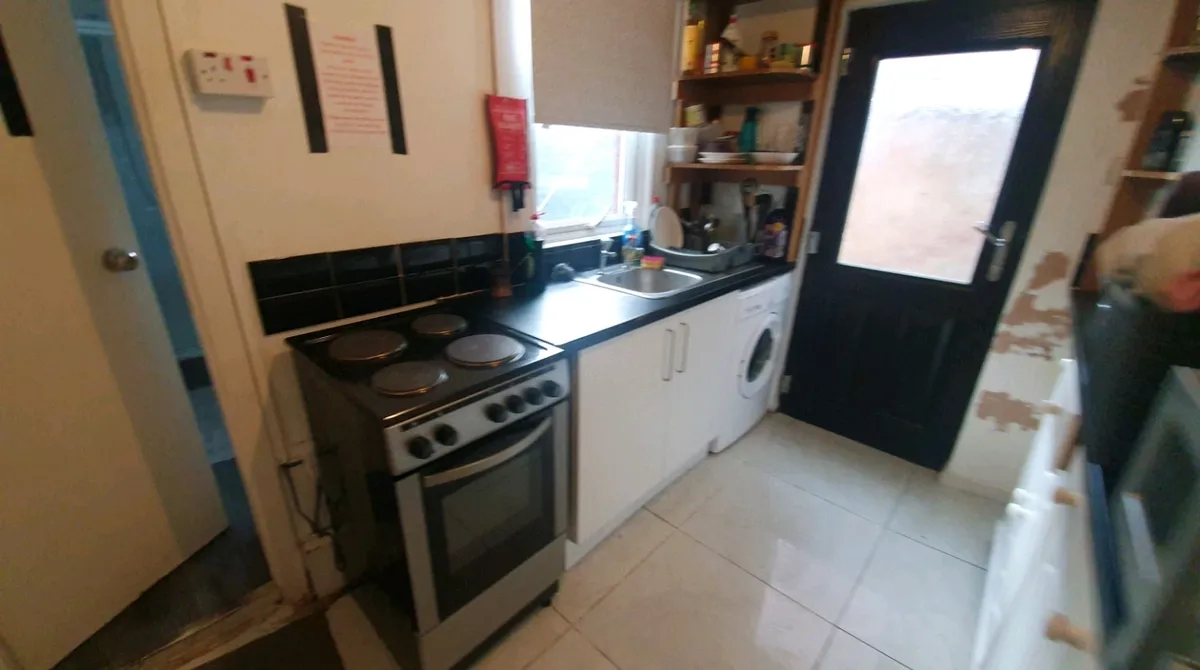
But how do they make their money? The answer is, somehow, by taking blurrry photos of a dump that has peeling paint and obvious damp and then getting people to live there.

And also by buying their showers from the same place.

Where is it? We’re in Salford, again, except the part closer to the university than the wetlands.

What am I paying? £475 of your British pounds per calendar month. £5,700 per year. For this. To watch the paint flake off the walls and the damp grow season by season. To lie in your box room with its unmatched furniture. To do this alone.

A bargain.

S13E06: Leading in ambiguity

This week I’ve been doing a lot of organising. A lot of cajoling. A lot of: thank you for this, now this. I’m trying to keep my patience, keep the pressure, keep the momentum of multiple things. But I’ve also had people respond to my requests for help, and others who’ve just said nice things.

Saying nice things is underrated. Let’s do more of it.

Continue reading

Manchester Rental Opportunity of the Week: Have You Ever Wanted To Feel Like Alan Sugar In Your Kitchen

The Apprentice is a show that is uniquely watched solely by the kinds of people who think they would win The Apprentice. They are convinced that they could outgame all of the other people whose only education in business is watching The Apprentice. In a certain way, it’s probably best that this is how it’s worked out. Imagine if everyone who watched Hannibal was also a cannibal. Imagine if your friends spoke solely in faux-therapeutic language and thought that lung was actually the thing to serve at a dinner party, and would sit there beaming and proud as you poked something that has the texture of mousse and the spongey consistency of sponge. Is this what being a grown-up means, you think, as you push lung around your plate. Sitting at a dinner with a cannibal trying to choke down the lung of some guy who sung a note wrong because, oh, the irony, that’s important. There’s only one kind of irony here, and it’s the taste of the blood in the –

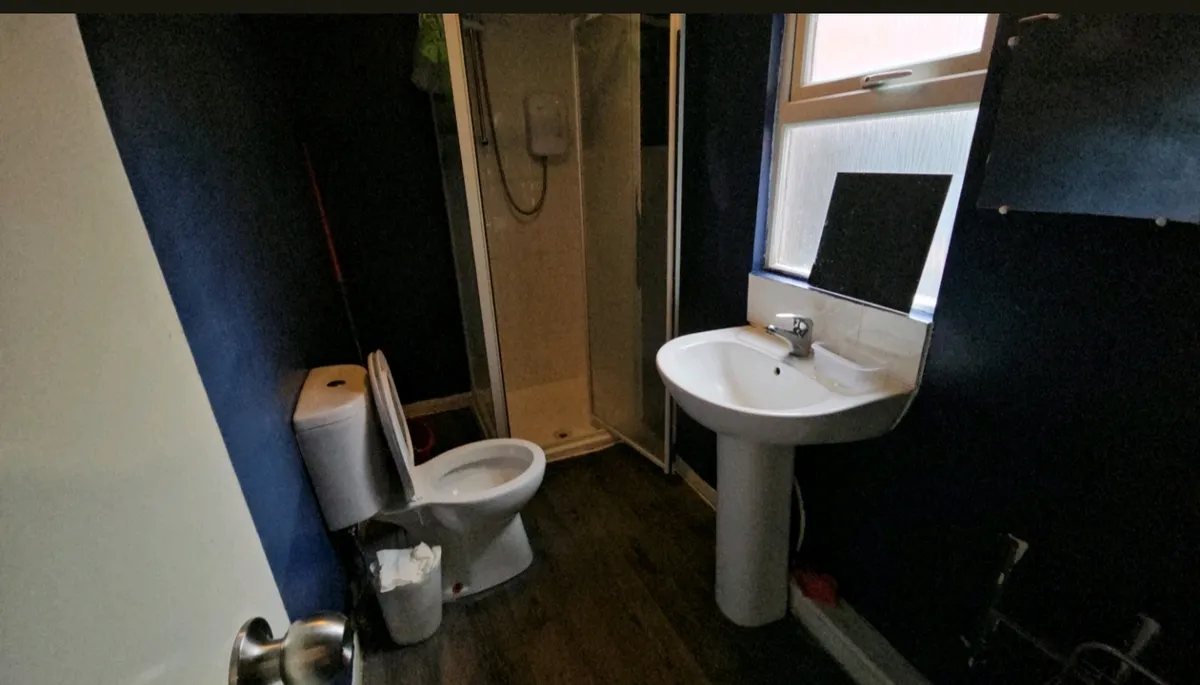
What is it? A single, ensuite room in a house share. The ensuite is designed for a two-dimensional stick-figure person. It is a wardrobe with plumbing.

The shower is so tiny, so narrow, that even a moderately enthusiastic episode of Onanism will give you bruises on your elbows. Luckily there’s not even room to fall over in there, so you can just let your legs give out and slump, standing, in the spray of the water.

If you told me this shower was actually a secret entrance to the Batcave, and that you could get in, cross your arms, say “Go go Batman power” and be dropped into a chute that yeeted you out into a secret hideout: I would believe you. I would climb in there and say those words with my whole chest.

Where is it? Kersal, in Salford. It’s just in the crook of the Irwell, which winds down towards –

Isn’t this Manchester rental opportunity of the week? Listen. Listen. Come here. Let me cradle your sweet, soft face in my rough, Northern hands. Listen to me. Manchester is like London. Remember? I literally said this last week. There is a ‘City of Manchester’. Is all of London ‘The City of London’? No. No it isn’t. If Orpington counts as London, if fucking Barking, which is in Essex, is part of London, then Salford counts as Manchester.

Okay, shit, sorry. So what is there to do locally? Nothing. Catch a bus into Manchester city centre.

But you just said -: Fine! There’s…green spaces. People like green spaces, right?

What am I paying? £650 per calendar month, at least to start. However, I think it’s fair to assume that at some point the landlord is going to sit at your kitchen/boardroom table and offer to negotiate with you. You’re going to look across the table at someone who owns the building you live in; owns the room you’re sitting in; owns, for some reason, this cast-off prop from season 1 of The Apprentice and you are going to realise that he thinks he’s Alan Sugar.

He wants to negotiate. He thinks that there’s an Art to the Deal. He thinks that walking away with more of your money will prove that he is a superior negotiatior, that in this battle of wits he has triumphed. He will not consider for a moment that he is holding over your head the threat of there no longer being a roof. Over your head.

Anyway. Snap this one up today. It’ll be more tomorrow.

Manchester Rental Opportunity of the Week

Joel Golby wrote a column for seven years about rental opportunities in London. It was brilliant. He was brilliant. He basically wrote the book on brilliant. Anyway, he’s dead now, I think, so it’s time for another overconfident white guy who really likes long sentences and a surreal meta-commentary on his own work to step into the gap, nay, the vacuum left by –

What is it? It’s a column, ideally weekly. If it’s not weekly, just pretend the title is different. It’s a column about the state of renting in Manchester. Manchester today is about where London was in 2016, which is when Joel started writing his column. By this I mean at least three people have told me that ‘London is coming to Manchester’, and they’ve said it with the same defeated tone that the Gauls used to speak about Rome. The pain. The exhaustion. And mostly the surrendering to the inevitable. London is coming. You will be assimilated. Do not resist.

Where is it? Here, to start with. With luck it’ll become so popular that I can rent a new domain name, a few electrons on the Internet I can call my own. Oh yeah, you rent domain names. You didn’t know that? Yeah, you can’t buy a domain name. You can have permission to use it for a while. You can buy a whole top-level domain, sort of. Hey, guess who owns the top-level domain .amazon? Reckon it’s any of the places where you’d find the Amazon rainforest? Of course it fucking isn’t.

What is there to do locally? Read this, I suppose, but you could also check out the other nonsense I’ve been writing for years on the Internet.

Alright, how much are you asking? Literally nothing. I’m doing this so I have one tiny corner of my life that is very stupid. But if you’d like to buy me a coffee, you can buy me a coffee. And since I live in Manchester, that’s actually much cheaper than usual. You’re actually getting a better return on investment here, which is a phrase that I truly believe landlords say in order to reach climax.

S13E04: Fighting my way through

I’ve been stuck on a bug that somebody before me last tried to fix at 2am. It is the kind of bug that compels you. It is the kind of bug that makes you sit up at 2am, convinced you’ve fixed it, only for it to remain stubbornly unmoving.

I have included a precis of it below, for anyone who knows about these things and would like to join me in the frustration.

Continue reading