We have a new minor version in production. Minor versions mean new functionality: here’s what’s changed.
Setting prices for line items
Administrators can now set prices for line items. If there are items that you charge a lot, you can now set them up in your Office Settings with a pre-fixed price. We recommend also adding a “Misc” charge that you can set on a case-by-case basis. Don’t forget that you can “charge” negative amounts, if you need to offer discounts.
Expanded search function!
You can now search by last name, first name, email address and production/event company
Minor changes
clicking on the logo in the top left will now take you to “My applications”, rather than “Applications” as before.
This is a story a friend told me, and has given me permission to retell. I think there are a couple of ways to tell it, and I’m going to try them out. It’s an exercise in writing, but also an opportunity to share a very good story. I am deeply grateful to her for the opportunity to retell it.
Alice is a 20-something professional living in London. Work life is going great; all other aspects of life are in the bin. So when a friend offers her the chance to go to a party she seizes it. At the party they’ve hired a fortune teller, and although Alice is basically cynical she’s also had a couple of drinks so she steps up when the fortune teller asks who’s next.
The fortune teller is your basic Barnum effect generator, and lists off things that everyone already knows about people in their 20s in London: stressed, living in cramped quarters, looking for love.
-Everyone’s looking for love, says Alice.
-You’re going to find it, though. The fortune teller gives her a conspiratorial wink, and declares that Alice will go on holiday and be introduced to a tall, dark man by a female friend. They’ll fall in love, but –
-But?
-But there’ll be a period of separation. You’ll end up happy in the end though.
That was it. Forty quid’s worth of fortune telling, and it’s that she’ll be introduced to someone by a female friend. I don’t know if you’ve ever been introduced to your partner — I hope you have — but it’s highly likely you were introduced to them by a female friend. So Alice goes away feeling not entirely convinced. All the same, she’s going on a short break to New Zealand. Maybe there’ll be something in it after all.
She goes on the break. She meets up with some old friends, and one of them introduces her to Max. And they get along like a house on fire. The whole group goes out to lunch, but for Alice and Max the rest of the table doesn’t exist. After lunch they keep drinking, because let’s be honest: millenials fresh out of university with too much disposable income drink like there’s no tomorrow.
There’s a good chance that our tomorrows are running out anyway, so who’s to judge?
Anyway: after an afternoon of day drinking they go to a club, they drink a little more, Alice ends up at Max’s flat. Things happen. Artistic fade to black, etc.
The morning is embarrassment and hunting for clothes. In a flat in New Zealand there is a little piece of Britain; a sock that managed somehow to escape behind the dresser and is holding out for the return of its owner. A few words are exchanged and Alice flees into the glorious sunshine and the embrace of her friends. The rest of the week she puts Max out of her mind and sees the sights; goes to Hobbiton, hikes over the beautiful countryside.
At this point it’s a funny story about the clumsiness of being young and attracted to someone, when it’s easier to have sex than talk about feelings. Then Alice gets a text: Does she want to come for dinner? -Max
So she does. And it’s just the two of them, but it could have been a dinner party of every person ever born and it still would’ve just been the two of them. They had a single drink each and then, just as she was leaving, he grabbed her and kissed her.
Again: people are bad at talking about their feelings.
So they’re kissing, and in the background fireworks are going off and the earth is shaking and I hope someone’s filming this because it is literally straight out of a movie. And then they stop, and his face is flushed and her lips are tingling and he looks like he’s about to say something, and then he doesn’t. And then she gets in a taxi and goes to the airport and flies away.
On the way back she nurses a broken heart and a gin and tonic — how is it that gin at 30,000ft is so much stronger than at sea level? — and thinks about that fortune teller. How she got everything right so far, so maybe there’s a chance that she’ll be right about the last part. That there’ll be a separation, but then they’ll live happily ever after.
She thinks about this for two weeks after she comes back. For the two weeks after that she thinks about it less.
They never saw each other again.
Look, I think that fortune tellers are frauds. Nobody can predict the future because everyone can change the future. Finding a person with whom you’ve got chemistry is pretty rare, and quite frankly I suspect it happens at the wrong time for a lot of people. (Let us put aside for a moment the tragedy of there being a wrong time to find a person with whom you have immense chemistry).
Actions are easier than words. Love is more than chemistry. All the same, if you’re reading this and it remind you of a woman who might not be called Alice; if it reminds you of yourself even though your name isn’t Max, maybe you should reflect that a story about what might have been is the realm of authors. A story of how the two of you fell in love and made it work across six thousand miles of air and sea is a better story, and one that really only you can write and tell.
Jean-Paul Sartre wrote a lot about being free. To whit: it sucks. This week I’ve mostly thinking about the fact that freedom is approaching me like a freight train.
Monday was a bank holiday, so I tried setting up an ISA. I failed. Bank websites are horrible. I’m completely bemused by how any institution with such clear and predatory competition can continue to be terrible. I also began revising hard for my Java exam with this very excellent free course from Coursera. It’s in French, which is good because I definitely need to improve my French.
I also read “Big Ball of Mud”⁰, which is an excellent paper discussing how beautiful software projects become jungles of spaghetti code¹. I really wish I’d read it sooner, and I’m putting it on my recommended reading list along with Boiling Frogs and the actual Agile Manifesto.
On Tuesday I had a very interesting interaction about IR35 and being a contractor. I’m considering it as part of my ongoing search for people who’d like to rent my brain, and that short conversation turned into a wealth of resources about being a contractor. It seems like an interesting life, but also fairly cut throat. If any readers would like to tell me why it’s the best idea/worst idea ever² I’d be indebted to you. I will of course write about it, unless I’m contracted to do work I’m not allowed to write about. In which case I’ll write about how nihilistic and existentialist media is³ currently in vogue as a reflection of our despair at the world.
So yeah, keep your fingers crossed for discussable topics
Ooh, and I offered to help Sam Villis make stickers which is an exciting little project. They’re going to say “Be generous”
At work I caught up with what happened last Thursday and started preparing for the objective setting meetings for my two Fast Streamers. I’m gutted I’m not going to be around to manage them through to the end of their postings; having had managers swap on me in posts I know how disruptive and frustrating it is. Leaving feels like a dick move.
I don’t have anything pithy here. It does feel like a dick move, and I don’t like it.
On Wednesday Spotify, a Swedish company, floated its stock on the New York Stock Exchange. To celebrate, the NYSE proudly flew the Swedish flag outside its building.
But before it did that, it flew the Swiss flag. Let’s not wonder for too long how or why this happened, but instead focus on the INTERNATIONAL DIPLOMATIC INCIDENT that ensued.
It's @Spotify's big day! The company is going public and @NYSE intended to pay homage to the company's Swedish roots, but flew our flag instead 🤭 It only took 15 minutes to fix this mistake, but no worries our Nordic friends are humble and we are neutral, so no tiff will ensue😉 pic.twitter.com/9k8wAtYVBQ
Your whole country is basically just made up of icy mountains, and your cheese is full of holes (but admittedly delicious) 🏔🧀 pic.twitter.com/q0XUdxzhgZ
I made some progress on an extraction-transformation-load project at work. It’s the kind of puzzle/problem/coding challenge that I absolutely love, so I’m trying to carve out time away from managing people to do this. Balancing this when I’ve still got new(ish) starters is tough as — at my insistence — I have a lot more contact time with them for them to identify problems. As they settle in I think they’ll get better at coming to me with issues, but at the beginning I want to be proactive and identify problems early. And then visibly act on them. Because:
I think managers should exemplify the behaviors they want to encourage. Take real vacations and don’t work while on them. Keep healthy working hours. Don’t stay plugged in after hours. Don’t hide mistakes. Take a mental health day every now and again.
Still, that cuts down on the coding/developing part of my job. I am currently finding that wanting to do both is hard to find in the job market: people tend to want one or the other. On the other hand, I’m finding it very hard to balance at the moment so maybe I’m the one being unreasonable.
Thursday is my non-working day, so I made approximately five kilos of ragu over five hours and it was absolutely flipping delicious. I also had a phone interview for a software developer role; way more junior than I am currently but the team seem really keen on personal development and mentoring. I’m really up for that: I like learning new things more than I like big salaries or fancy titles.⁴
In the afternoon I went to see the aforementioned Sam and we talked about fonts. Talking about fonts is brilliant, and if you like fonts⁵ then you should watch Helvetica. I refuse to link to the trailer because it’s terrible. The ratio of how bad the trailer is versus how good the documentary is can’t be understated. It’s terrible. Fine. Fine. Here it is.
90 SECONDS OF THE SAME, HORRIBLE, REPETITIVE NOISE. Oh look, Helvetica. There it is again. And again. And — yes, I get the point. Now we’re going to find out wh-oh, nope, it’s just another example. GET TO THE POINT.
My point, by the way, is that fonts are cool, and mint tea served in Grind at the Whitechapel building is exceedingly minty, and sometimes seeing a friend and talking about fonts segues into reflecting on what you’re actually doing. And that’s an analogy for weeknotes.
On my walk home a recruiter contact of mine got in touch, and since his building was on the way home I swung by. He’s in the Heron building. It has horrifying, outside facing, glass elevators. I hate them. I can feel my intestines trying to escape via my throat in an attempt to wind themselves around a nearby post and arrest my movement every time I approach them. But since his office is on the eleventh floor and I don’t do enough cardio to make that feasible, I clenched my everything and rocketed upwards.
Seriously, this gives me the willies.
He’s found a job that would suit me almost perfectly — and that sounds like the kind of coaching/developing role that I’m aiming for — and he’s going to Poland this weekend. We chatted about the role and I made a request for vodka. Keep your fingers crossed for the safe delivery of both.
I cannot undersell the gloriousness of this vodka. It is exquisite.
On Friday I chickened out of telling one of my Fast Streamer’s managers that I’m leaving soon, and I’m still trying to work out why. There was a perfect opportunity, and yet for some reason I didn’t. I’m going to think about why I did it over the weekend. It was weird. I still feel weird about it in a way I can’t really define, but I think it’s linked to what I said above: saying it out loud confirms I’m thinking about myself more than them. And that feels like a dick move.
I got confirmation for another software engineering role, although this is with an organisation that’s got mixed reviews from people I’ve spoken to. I’m waiting to reserve judgement, but it’s making me nervous before I start.
This weekend I’m finishing up coursework about a travelling salesman and a project called “Philip Hammond and the Temple of Glom”.
Like I said. Nihilism.
⁰ This is my new band name
¹ And this is our first album
² No equivocators please
³ Media is singular, don’t @ me
⁴ Although I confess I would very much like to become the world’s second Head of Data and Search
Go to Bletchley Park. Do it at once. It has had love and money thrown at it in equal measure, and it shines through. There are fifteen separate high-quality exhibits, and I cannot stress enough how very, very brilliant they are.
You will need at least four hours. Really, you should take six.
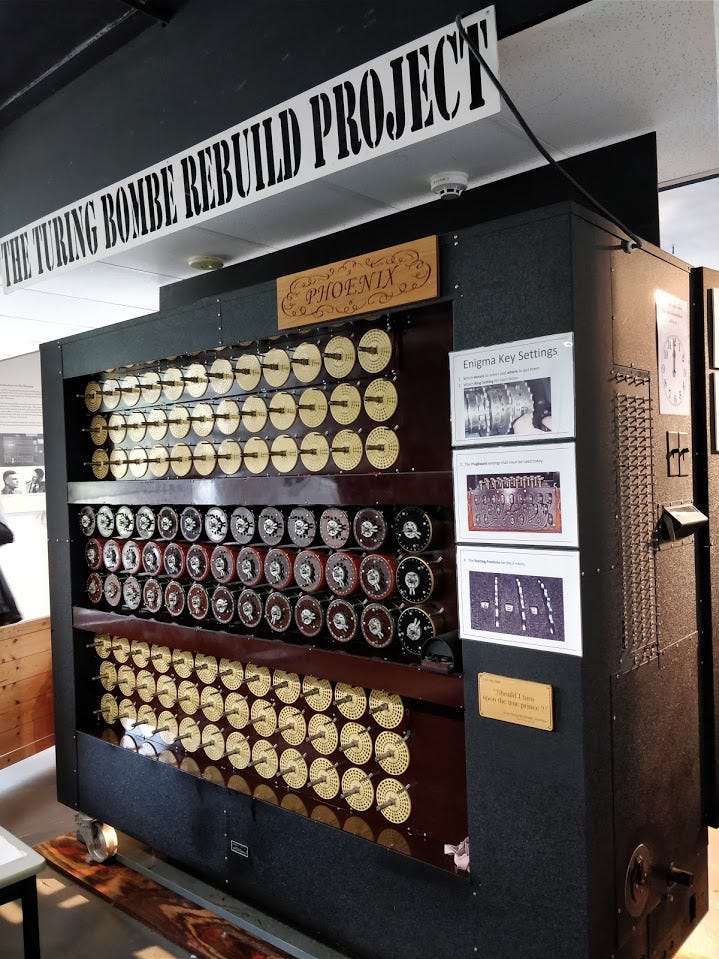
Go and see the replica Bombe machine. It clacks merrily away in a room full of machines that were used in this quiet corner of Buckinghamshire to win a war. It’s explained by a cheerful old fellow⁰ who patiently explains the Enigma’s encryption process to a room that is split, 75/25, between eagerness that borders on fetishism and polite bemusement.
Seriously, this is extremely cool
That talk happens in a two-storey converted house, and the upstairs contains real former employees talking about their experiences on video scattered through impressive visual displays.
Do get the multimedia guide, because it’s absolutely riveting. A huge amount of research has gone into it, and experiences from veterans who served here have been captured for posterity. My favourite was an extremely upper-class woman: she talked nonchalantly about working alongside these fellows who were very close to genius, but seemed close to homicide when asked what they were like: “very untidy!” was the curt response. It also comes with a pair of natty headphones that give you an immensely jaunty air:
I cannot express how much I look like my dad in this photo. You’ve probably never met my dad, but at least now you’d recognise him in a crowd.
Do not go to the shop if you like both books and a full bank balance: you will leave without one or the other. For me, I chose books.
I chose…wisely
I’ve come away with a spectacular haul of slim puzzle books, a thicker puzzle book, and The Code Book by Simon Singh. I can’t commend it enough: it’s fascinating and completely absorbing. I am entirely hooked, and I offer any one of my readers the opportunity to commune with me via Vigenère cipher.¹ My inbox is open.
Throughout the site are various exhibitions designed to get you to understand how Enigma works. I was about three hours through before I felt reasonably sure I got it — there was an immensely enjoyable 3-D X-Ray rendering of the innards of an Enigma machine and it sparked a lightbulb moment. It feels as though everything is designed with that sense in mind: a feeling on the part of the people who built these exhibits that they themselves could barely believe that this had happened. The massive concentration of brainpower that was unleashed there is really quite something and it’s testament to a principle I cling to today: free up people to do good work and they will stun you with their brilliance.
They will also sometimes hurl coffee cups into the lake rather than return to the canteen, where their thought processes will be interrupted by people talking to them. Accept that as part of the cost of doing business.
There is a reek of privilege everywhere. It really can’t be avoided — as much as it’s played down, the people who were recruited were those privileged few who’d had the opportunity to learn German, Japanese, Italian and so on at school. Daughters of aristocrats were the first called up to support the staff because “We can trust that sort of person to keep secrets”. It’s a sign of the times: today, all three branches of the security and intelligence agencies are making massive progress to recruit more diverse individuals.
Let me close by saying that there’s a restaurant in Hut 4 that serves incredibly tasty, fantastically cheap food to refuel you after the literally tens of kilometres you’ll walk. And if nothing else it’s a lot of fun to walk around and, with hundreds of other people, quietly mutter
Hang on, say that bit again?
⁰ Don’t expect to see many women. Although there are many fascinating exhibits about the Wrens —members of the Women’s Royal Naval Service — there wasn’t anyone presenting that wasn’t a robot or a cheerful old fellow. It was a bit surprising, and something I hope will change soon.
¹ I’m sort of tempted to build a decoder based on the fascinating methods contained in the book, but I fear it has both already been done and would be of interest only to arch-geeks like myself.²
On Thursday my partner and I headed to Milton Keynes to spend a long weekend GEEKING OUT. We went to Milton Keynes for its proximity to Bletchley, the historic home of the Codebreakers.
There are two interesting places on the site of Bletchley Park. The first is Bletchley Park, and the second — hidden away at the back — is the National Museum of Computing.
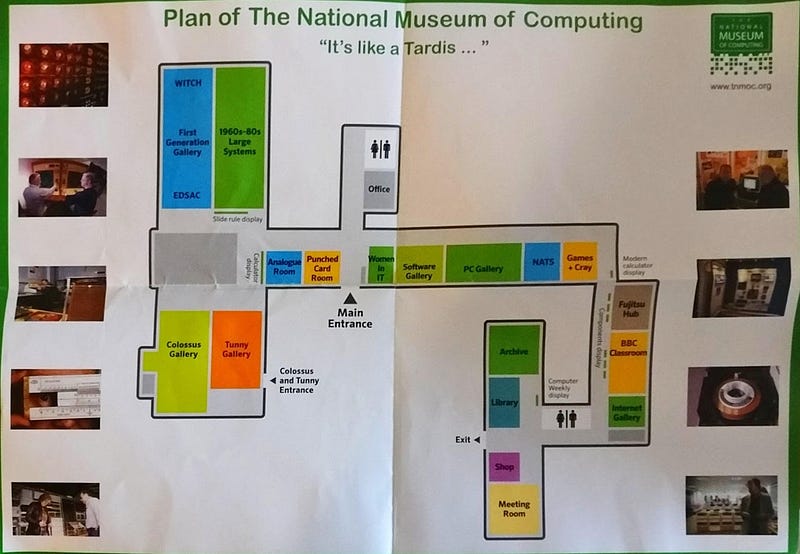
I’ll start with TNMOC, as they like to call themselves. They give you a map at the entrance, and it sums up entirely, in a single image, the entire spirit of the place: earnest, geeky, and lacking in polish.
There is so much that’s glorious and good there. The depth of knowledge the staff have is unparalleled, and they are incredibly willing to share stories and explain complex ideas patiently and, in my case, multiple times. Apparently the following was a key understanding in how to break the complex Lorenz cipher:
A + C = F
F + C = A
but I’m afraid by the fifth time I was too scared to ask how and just nodded sagely. Answers on a postcard please.
But on the other hand, everything is very slapdash. For example: they have a series of wonderful collections of automatic calculating devices that appear to have simply been thrown into a cabinet together. It would have been wonderful to see the evolution of these fascinating machines from slide rules to the modern calculator, but instead it was just a mess of wonderful, unstructured pieces.
With that being said, the display and explanation of the Tunny and Colossus machines were worth the price of admission alone. They are incredible feats of love and dedication. Since they were used by secret organisations, both the machines and their designs were all (supposedly) destroyed at the end of the Second World War. By virtue of sheer determination, a group of hobbyists, amateurs, and former engineers have recreated these remarkable calculating machines.⁰ Colossus in particular is an incredible machine; an early calculator that could do addition of five-bit binary words at an incredible rate for the time.
The guide spoke assertively about the machine, and then gave us all a little slip of paper to translate. For fun, here’s the slip:
Ooooh, mysterious!
It uses the five-bit ITA2 code to encode Roman letters to dots and blanks.
It was a really pleasant way to end the exhibit and a lovely, tiny peek into the work of the machines and — more importantly — the human beings behind them.
The most pertinent example of this allowed for the creation of these incredible machines: a single mistake by a German officer allowed a brilliant mathematician named William Tutte to divine the structure of the encoding machine without ever seeing it.
This is an absurdly impressive intellectual feat. Completely, utterly, mind-bendingly impressive.
It is approximately equivalent in my mind to seeing a single drop of blood and then deducing the entire structure of the circulatory system. Of an alien.
But I digress. TNMOC is a diverting couple of hours and the massive machines are brilliant. But Bletchley Park is far, far superior. So I’m going to dedicate an entire blog to that subject.
⁰ I will be writing more about ciphers and cracking these the moment I actually understand them
I have two new colleagues on short term contracts — loaned from the Civil Service. One immediately went on annual leave, while the other has been hard at work. It’s been absolutely eye-opening. As they’ve grown into the project they’re working on, they’ve freed up a huge amount of the mental energy I didn’t even know I was expending on it. That, in turn, has made me so much better at my job.
My point is probably that if you get to the point where you say “I’m too busy to hire someone”, you should hire someone.
So: Monday I had a one-to-one with my colleague. I ask the colleague to come with an agenda and share it with me ahead of time, so I don’t get blind-sided by big questions. So far the approach has been effective; my colleagues are thoughtful and honest, which has helped guide the way I do my job. I’d like to learn more about ways to improve them, so if you have suggestions please throw them at me and I’ll try to collect them.
It was the last week of term and the UCU strike had ended, so I had my last programming class before the exam. It was a valuable session; I’m still getting to grips with Java but made some progress. I am still entirely confident that it is a terrible, horrible, no good language, but it’s helping with the very good Scala course I’m doing. It’s on Coursera and it’s created by l’École Polytechnique Fédérale de Lausanne, and if you’re interested in functional programming I recommend it.
In job news, I found out that a position I’d applied to had already been filled — but would I like to meet the director to talk about joining a different team?
Tuesday was backlog grooming, which the aforementioned colleague facilitated, and customer problem solving. Backlog grooming is an opportunity for the business side of the operation to come together and argue priorities and roadmap. It’s really helped to get the new colleagues up to speed and helped me sharpen up the product’s vision, because new colleagues have a tendency to poke holes in assumptions you didn’t realise you had. If you don’t have any new colleagues to hand, you can always borrow some from a neighbour.
I applied for a job that required me to take a situational judgement test. Situational judgement tests ask you to image yourself in a situation and then evaluate four responses to the situation. Apparently you can automate cultural fit now, which I have two conflicting thoughts on:
Tech bros hiring for cultural fit⁰ is a contributing factor to the lack of diversity in our industry. By writing down what your culture is and letting a computer check if people react in the same way as you to the same situation, you can remove some bias you would have for or against that person. But:
Culture is mostly unwritten; the people who commission and input into this software don’t deal with the day to day culture; the idea that you can neatly encapsulate vast, unspoken cultural stuff in 15 questions with four answers is patently absurd.
In any case, the test identified me as a bad fit. It was a novel experience though, and gave me insight into a dystopian world of automated decision-making that can only be just around the corner.
UNACCEPTABLE
Wednesday passed without major incident, and I took advantage of the evening to finish up the work I was doing on my side project to make the algorithm work and the interface usable.
Unfortunately, it takes a long time to process the data, which means if I deploy it anyone who tries to use it is met with this page:
bummer
So: now I’ve got to write something fancy to move the data processing to the server-side while the client-side displays an animation to keep the user interested.
I’m frustrated, but I’m also learning new things that I’m really enjoying. So that’s nice. It also works as long as you only ask for ten data points, so if you promise not to break it you can try it here. If you feel like a fun challenge, print off the data points you get and see if you can get better matches than the system.
(If you spot any horrendous results, please let me know!)
Thursday was my day off and my partner worked from home, so I made some fish with a dill sauce for lunch. Eating together is something we try to do as much as possible because we’re both so busy, and it was really nice to be able to do lunch as we wouldn’t have the chance to eat dinner together.
I went on to university in the afternoon. Information systems got a bit heated as we discussed ethics in computer science. There’s a whole thesis to be written on whether our industry ought to be regulated in some way, and now’s probably not the time.¹ There are also theses already written about the actions of Snowden and Manning, and the recent whistleblowing about the stunningly shifty activities at Cambridge Analytica². People have Strong Feelings about this stuff. It’s a good start.
Computer Systems was a blur of confusion. I’m going to be spending my (now free) Thursdays before the exam reading the textbook from cover to cover.
Thank goodness for student loans
Friday everything was on fire.
Customer issues came in from left right and centre. A client was accidentally missed off a mailer a couple of weeks ago and found out today from someone else in their industry. I’m really frustrated that we dropped the ball, particularly because this client has a unique insight into upcoming work that we really value. It also makes us look unprofessional and I really, really hate that.
I had to crunch through some tests for another client, and because computers can smell your fear that was the moment my laptop decided it was time to do updates.
COME OOOOOOOOOOOOOON
Matters were made worse by the fact that the afternoon was given over to the retrospective. Some tough conversations happened, as they should do, but I came away from it wondering how valuable my input was. I felt as if I’d done nothing but complain, and I don’t like that. There’s plenty of good to celebrate, but I felt like I was playing the bad guy. I’m going to keep an eye on this and see if it resurfaces in a fortnight.
Next week
Incredibly short week, so work will be crunchy as I bring everyone back up to speed. On the other hand, bank holidays are good and mini-breaks with your cool and awesome partner to Bletchley Park AND the National Museum of Computing are the absolute best. Next week’s weeknotes will feature many pictures of my immensely excited face.
⁰ Cultural fit is a phrase which here means “Are they, too, a tech bro?”
¹ Since you ask: pilots flying planes today rely heavily on software. Despite this, pilots are highly regulated and rightly so. But the person writing the software — who’s regulating them? As far as I know: nobody. And if that’s the case, it makes me nervous.
² This year’s favourites in the boat race against Oxford Analytica
I’m going to preface this blog by saying: I’m really lucky I can write this blog. I know most people can’t. This is also mostly a way for me to frame what I’m thinking, because writing it down helps me and maybe it’ll help someone else.
This will probably span several posts. Sorry.
I am looking for a job.⁰ I’ve managed to save enough that I don’t need to take the first position I’m offered, and I’ve got enough time to think about what I want to do.
At the moment, it’s something of a mess. It means I’ve taken a slightly scattergun approach to job applications. I’ve nosed out interesting things and applied to the best of my ability, and then had valuable conversations with people who turned me down.
(I did have one conversation with a recruiter that I can only apologise for, because in the middle of a cracking answer about how I’d supported a member of staff to write their own web service an idiot in a low-clearance vehicle got stuck on a speed bump outside the cafe I was sitting in. And then revved his engine. And then I yelled ‘I can’t hear you, I’ll call you back’, which probably threw you a bit. And then I realised you’d called from a private number, so I couldn’t call you back.
The whole thing was a farce. I’m really sorry.)
Other people have taken me up on applications. Those conversations have been enlightening too. I spoke to a startup founder who admitted that at one point in the last week he’d been awake for 44 hours.
Another is looking for a CTO to do the technical stuff and eventually manage a department. For the moment, the founder’s brother had promised to lend a hand. I asked what Twitter thought of this.
In the words of the Oscar winning movie: Get. Out.
Then of course there’s the other end of the chaotic-lawful axis: a return to the Civil Service. It was always my plan, but in the year I’ve been away I have apparently forgotten how to write competency statements. I fear this is because competency-based questions are just a horrible way of trying to work out if someone is competent¹.
These two environments are wildly different, and yet I find myself drawn to both. The desire to build a culture from scratch because I believe I know best has more than a whiff of both despotism and arrogance. At the same time, I don’t think I’d do it if I didn’t think I was right.² That desire clearly steers me away from the Civil Service, where the organisations are too big to start a new culture unless you have serious clout and unlimited patience.
On the other hand: I know the Civil Service, and they are working on incredible stuff. It’s an incredible time, with genuine transformation going on all over the place. At the same time, all of the infrastructure — the HR systems, expenses, etc — are horrendous. On the other hand, there must be teams working to improve that stuff, and I really like finding problems and solving them.
And then of course there’s other stuff. More established start-ups transitioning to SME status; consultancies that aren’t the soulless Big Four; local governments, national governments; and odd corners of the business world that are suddenly transforming. And within those there’s such a depth of possibility: from apprenticeships to to Chief [sprinkling of letters] Officer.
I’m going to write up something else where I’m going to start thinking about those paths. I know I want to always be learning; to have a culture that reflects stuff I care about; to be creative; and to solve interesting problems. Let’s see if I can find that stuff anywhere.
⁰ If you’re thinking about a vacancy that I might be good at, I’d love to hear from you.
My partner stayed longer in Latvia than me and arrived back on Monday evening. We were both starving and in no mood for cooking, so we selected and ordered food that arrived at our house shortly after us.
We live in the future and it is unbelievably cool.
I finished one piece of coursework — it solves sudoku⁰. It takes less time to solve than it does to write them in. I think that’s a good metaphor for computing generally.
Lines required to convert an array to a set in python: 1 Lines required to convert an array to a set in Java: literally nobody knows its forking impossible
I was approached to write some software for a group of people I respect to help them achieve some awesome user needs and felt bad about charging for it. I would like for this to change, either by me becoming more comfortable with the value of my own time or the immediate implementation of Universal Basic Income so I can just do it for the love of doing it.³
A vast oversimplification but still a valuable tool, and better than the actively awful Myers-Briggs test
I spoke to my peer mentor Morgan, who is wise and brilliant. She put some pressure on me to reflect more deeply on why I’m leaving, and it’s been immensely helpful. She’s also suggested some avenues I hadn’t considered for new jobs. All this from a chalet in the Alps!
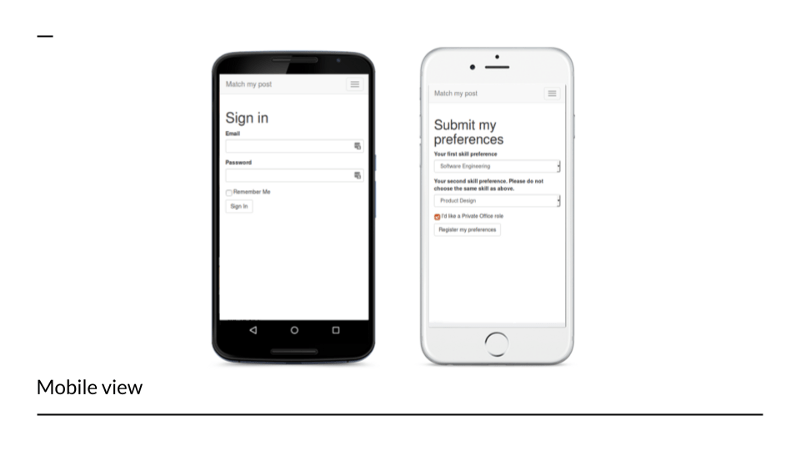
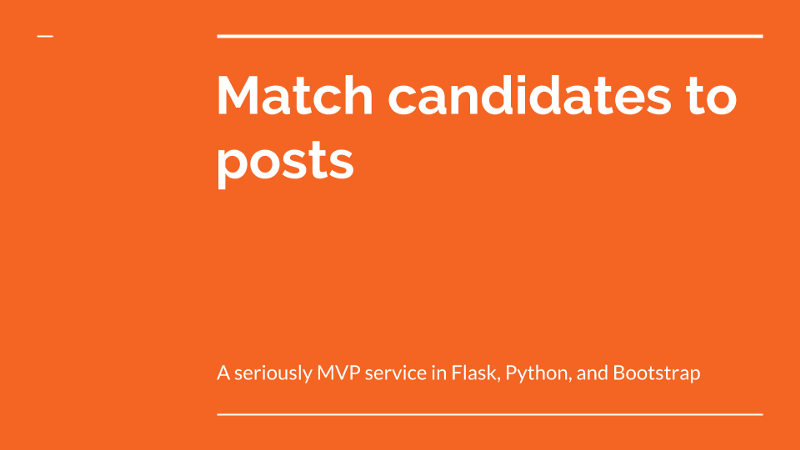
Finally: I made more progress with my side project. I’m making a pitch deck, because I figure if nothing else it’s good practice. Plus — and I have to whisper this –
I actually quite like slidedecks for transmitting information
For example:
Oooooh, mobile
Aaaah, numbers
What didn’t go so well?
Today — Friday — was a bit of a crush of different things. I didn’t get everything I wanted done because there was a lot of context switching. We’re getting back into our clients’ peak seasons, which means our customer support time suddenly picks up again. Normally we’d be okay, but we’re thin on the ground when it comes to staff right now and it meant I had to keep picking up the phone. No easy solution here — I’m just going to need to sweat it out until I get my new person trained up.
The approach to write the software I mentioned above came at the start of my lecture on Thursday, and I couldn’t focus properly on what was being said as I was thinking about database structures.⁴ That makes for a funny aside but it’s not easy work, and I need to be better at putting my stuff away and not being distracted. I’m going to try an old-school notepad approach for the next lecture to see if that helps.
Lastly, I got feedback that I am sometimes so blunt as to be unpleasant. One of the reasons I blog is because with the space and time to think I (think) I can say what I want in a way that’s efficient and eloquent. When I’m pushed for an answer on the spot I tend to be abrupt, because I feel like my inquisitor wants an answer now. That’s an explanation of why I’m like that, but it doesn’t take away from the hurt I cause when I am like that. And I strongly believe in the principle that the more senior you are, the greater your responsibility to adjust your style to suit the people who report to you.
I’m going to work harder on this, so if you see me in the next four weeks and find me being unpleasantly blunt, I’d like you to call me out if you’re up for it.
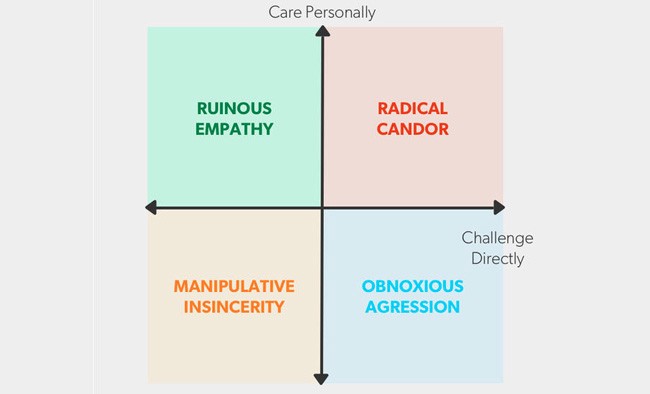
I’m down in the bottom right. Where do you think you are?⁵
⁰ Japanese doesn’t really do plural nouns, and it’s the kind of tiny grammatical hill I’d die on¹
¹ sorry, on which I’d die
² fangirl is the gender neutral term, don’t @ me
³ fingers crossed for the second one
⁴ Database architecture is the most perfect in-between for people who like constructing theoretical shapes to solve problems and people who like making things. You’ve not lived until you’ve seen tables you’ve designed filling with neat, efficient rows of data.
⁵ This diagram is from Radical Candor. It’s a book with a whole host of questionable suggestions, and there’s plenty to argue about the extent to which vulnerability and honesty in the workplace is a good thing. All the same, it’s worth reading.
I also had to come clean to my colleagues and, here, to you. I handed in my notice. I will, quite soon, be leaving my job.
Preparing for your own succession is very strange, because it feels a bit like what I imagine planning your own funeral feels like. You know that everything else will go on without you, and the first reaction is a very selfish “Why?”. It’s only fleeting, but for a moment you feel irrationally annoyed that people will keep coming to work once you leave. Clients will keep calling. New business will roll in. Things will, for the most part, stay the same.
My first instinct is annoyance, because I am obviously the centre of the universe and if there isn’t forty days of mourning and mandated black clothing then really have I made any impact at all? If there’s no fuss, have I somehow failed?
Then you get the wonderful second thought that says: if everything falls apart the minute you leave, then you’ve done a terrible job. If people can’t cope; if the team can’t grow; if clients will abandon the company without you then you have made yourself invaluable. And that’s bad for you, because you’ll never be able to leave; and it’s bad for your team, because they’ll never grow without you.
The health of an organisation depends on people being able to move between teams, to transfer knowledge, increase connections and work on the right things.
I’m proud that when I leave in May, I’ll leave behind teams and people who are in a better, more positive, more powerful place.
In the meantime, there’ll be a job advert and interviews, all of which I’m really excited to take part in. The best part of leaving a job is that you can drop back in afterwards and see how it’s going. That’s a privilege that’s unfortunately not necessarily afforded to folks planning their funerals.⁰
I may need to omit these things from my weeknotes, because they’re naturally confidential and sensitive. Instead, I’ll be throwing in more from my MSc and from my side project.
Describing this service as niche probably gives it more credit than it deserves
My side project is something that’s been bubbling away under my brain for a while, and I’ve finally pulled my finger out and started to design it properly. I’ve written about it before, but it’s always really been an exercise to see if I could code the problem. Proofs of concept¹ do not a service make, so I’ve started developing a front end to interact with it.
It’s really hard, despite the fact that I’m mostly cheating on all design issues by using bootstrap. Working out what users need to be able to do is just as hard as working out how to write the code, and writing the code properly — rather than as an incomprehensible mess — is really darn hard.
So what about real work? Well, I’ve got three months before I leave for good, and enough squirrelled away that I can be careful about what I do next. I’m getting a better sense of what I like doing² and how I like working³. If you’re interested in hiring someone a bit like me, you might well be in luck. Drop me a line and let’s talk.
Like the person planning their funeral, I can’t say for certain what’s next. But — and I hope I’m still saying this when I do come to that long-awaited day — I’m really excited to find out.
⁰ This is of course a personal view. Depending on your spiritual outlook, you may be able to come back and affect things, come back and just watch over things, or come back as a totally different thing and affect other things entirely.
¹ I think that’s right. Proofs of concept? Proof of concepts? Proofs of concepts? English is a mess.
² Systems design, writing code, solving problems, coaching, mentoring
³ With autonomy, with responsibility for developing others, with freedom
If you can’t see, it basically shakes out to about 25% each for sales, CTO stuff, and Product Owner-y stuff, with the rest given over to admin, customer operations, and eating lunch.
Eating lunch is important team. Protect your lunchtime like a mother bear protecting her cubs.
The sales part is because my boss is taking a well-deserved break, so I’m managing that part as best I can while he’s away. It’s a massive gear shift from CTO work and I can’t say I love it, but speaking to customers is always positive because sometimes they’ll have a brilliant feature idea that I hadn’t had.
I spent most of Monday on the strategy and budget for the next couple of years, as well as writing up a training agenda for a new customer that I’m going to see very soon. I wrote code for ten minutes, and as you’d expect it didn’t work.
I got a ticket to #ukgc18, which is SUPER HECKING EXCITING
This guy knows what I’m talking about
And in the evening I went to university, and I think I’ve started to get Java.
On Tuesday I spent half the day on a new guide for customers using our new, fabulous, mostly-automated, product-generating-machine. The rest of the day was a struggle, because my esteemed colleague Felix had secured himself a couple of days of user research training. I answered emails and fixed a particularly difficult customer issue, and since I was feeling pretty pleased with myself I reopened my pet project: software to organise the shuffling of people, when there’s people to be shuffled.⁰
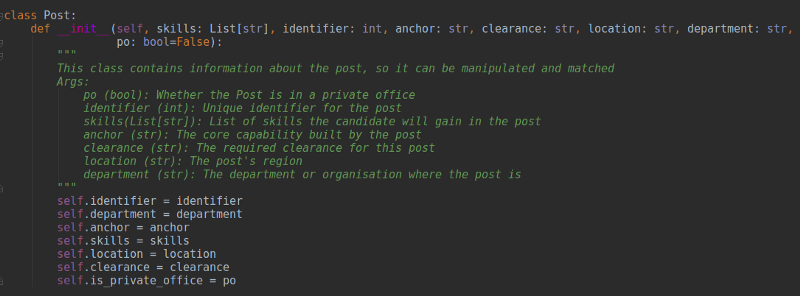
And I got weirdly annoyed that you can’t specify the type of arguments you pass to functions, so I googled it and it turns out you can¹. So now my code looks b-e-a-utiful:
I’m using the Civil Service as a use case, but it would probably work anywhere
It’s good brain exercise, and maybe one day someone will find some use for it.
Wednesday is retro day, and I think this has been the most successful one yet. We came out with some really great metrics for things we could do better, gave each other meaningful praise, and generally came out as a better team.³ It was a good feeling. I love retros, but to be fair I’ve said that a lot before. I do. Continuous improvement forever. Continuously.
In the evening I developed my software’s logic a bit more. There are a lot of things to check. I suspect I may need a data scientist before long.
On Thursday I went to uni, finished my coursework, discovered the administration office for my program and had my first Computer Systems lecture, where I learned that the average mark was 49% and a pass is 50%.
It’s a day that starts at 1330 and ends at 2100, which is just incredibly unfair. All the same, what I’m learning is incredibly cool — although I’m still struggling to link it back to my day-to-day.
If I’ve made a mistake, it will at least hold the record for the most expensive mistake of my life to date.
Friday was an office day, and Felix and I finally got to check in. I had a preliminary chat in the morning with a potential new employee — my first in this new role — and in the afternoon did some pairing with Felix. We did sprint planning just before we went home, and the team talked me through what they’re going to be doing next to meet the sprint goal. It was non-stop, and a couple of my meetings ran over. They ran over because there were important things to discuss — is there any way to make that kind of meeting run to time? Help please.
If you’re going to be at #ukgc18 tomorrow, give me a wave. Some of us weeknoters may be pitching on this very subject, so…watch this space?
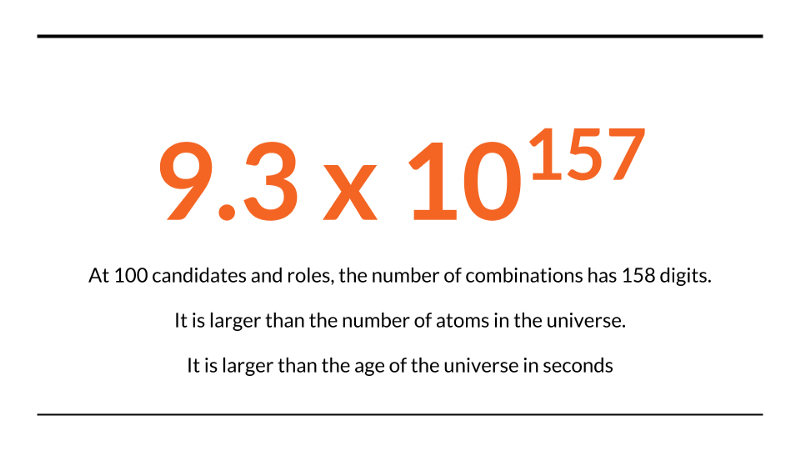
⁰ Okay, this is a weird obsession of mine, but: a number of graduate programs rotate their grads around departments, business areas, planetary moons, that sort of thing. They do this with the aim of turning out all-rounders. Unfortunately it’s a thing that seems simple and turns out to get trickier quickly, and I’ve been trying to convince HR teams to use computers to do it. I have been doing this approximately forever. I’ve now given up now, and it’s turned into an exercise to see how pretty/artful/efficient I can make my code. I’m now down to 23s to match 500 candidates to roles, with each candidate getting a match 80% suitable or better.
¹ Java man, it creeps up on you. It’s a gateway language, before you know it I’ll be functional programming and ranting about monads.²
² Wow, that is a specific joke
³ Metrics are important, as long as they can be linked to an actual outcome. When faced with a meaningless metric ask why until it goes away or you understand it.
















 Caffeinated Punctuation