It happens to me regularly, and on Friday I was nerd-sniped by Jamie when he posed this into the ether:
I've been doing data projects for yrs & still don't have a consistent way of organising things. It's doing my head in. Anyone have a system for organising #rstats, #python#qgis & web stuff on a project by project basis, but with a way of keeping them accessible across projects?
System and data design is kind of my bag, so I immediately shot back that a database would be best but a web api would be super cool.
And then, because I’ve been itching to try out something serverless, I built a tiny proof of concept. Tiny in capability. It took me most of today to actually do.
Jamie pointed me towards a juicy dataset from the Department for Transport concerning road accidents. I threw three giant CSVs into a database, and then struggled to put them into an AWS relational database (RDS). Setting up a cloud-based database is difficult, because the default way of doing things appears to involve spinning up a separate machine to export data onto, as a sort of staging server, and then moving that onto the database server.
Eventually I hacked around it by temporarily opening the database up to everyone, frantically throwing stuff in there, and then locking it up again. It doesn’t seem sustainable. There’s another column in there that I don’t really need, but I can’t work out how to drop it without the enormous palava I went through just trying to get it on there in the first place.
It’s at this point that my brain does the thing that is the basis for a joke that I quite like.
Suppose you are given a phone with a smashed screen that seems otherwise to be working. What should you do if you wish to keep it? Naturally, the answer is to take it to be repaired, pay a fee, wait some time, collect it, and wipe it, ready for either resale or reprogramming. So far so good. What, though, should you do if you are given a phone whose screen is unsmashed? Simple: smash it, thereby reducing the problem to one you already know how to solve.
There are a number of variations on this joke, involving Newton and cats or physicists and kettles. The reason I’ve written it like that is because me — or that bit of my brain that gets itchy around imperfect systems — would very much like to just burn the thing I’ve built to the ground, because the solution to my current frustration is hard and unknown while rebuilding it is just hard.⁰
In any case: getting data into the database was very hard. Actually building a tiny little function to grab data and return it was easy: the whole code runs to about 30 lines. It’s also not much use at the moment. It just returns the primary key of an incident report, but does at least give a genuinely horrifying glimpse into the number of traffic accidents that happen on our roads: 129,982.
I’ve not open-sourced the code yet because it’s got details in it (bad practice), but I’m going to continue tinkering with it. I’m not sure how more persistent things, like a database connection or an object relational mapper, fit into this invocation model. Only one way to find out.
If you’d use an API like this, what data would your web application like to consume? Answers in the comments or to me on Twitter
⁰ I’m skating close to something honest about my romantic relationships, so I’m going to do a quick pirouette and skate in the opposite direction
The weird double-episode in the middle of the season that makes you sit up straight in the luminous glow of Netflix and go, “Oh shit, is it the season finale already? Did I really just shotgun 13 episodes of this show? What kind of rotten monster — oh, okay. It’s that weird mid-season double episode” and then you sink bank into your nest of blankets and tea.
Relax. Sink back. We’re not at the finale yet.
Way back, last Thursday, I went home early because I felt rotten: the beginning of the flu. I’d already volunteered to help out at SiliconMilkRoundabout, and figured I’d be better by Sunday.
I was. I definitely wasn’t well enough to use five hours of spoons being extroverted, but I was well enough to stay at home, maybe go for a stroll and see a friend for a coffee.
Hey, reader. Guess which one of these I did.
So then it was Monday and I was huddled in my snuggliest blanket drinking my largest mug of tea and generally feeling monumentally hacked off at past me, the me who overdid it.⁰
This week I’ve mostly been struggling with imposter syndrome as I try to get to grips with Jenkins. It’s software we use to automate software deployment, and this is my first time getting deep into the guts of it. Like all projects that have been around for a while it seems like a horrible, screaming mess at first glance. I’m confident I’ll get there, but the learning curve is sharp.
What I’ve noticed is that I’ve been tracking my time less when I’m struggling at work. I think this is some kind of avoidance behaviour, so I’m going to dig into it a bit more and work out what it is I’m really doing.
Brains: they’re weird, and they control your life in ways you don’t even notice.
Red team! Assemble!
The team got together and reviewed our threat vectors and attack trees. Attack Trees are constructed from the point of view of the adversary. Creating good attack trees requires that we think like attackers, which I’ve got to admit gives you a bit of a thrill. We broke down all the ways different attackers could try to get into our system, and found that we’d plugged all but the most expensive gaps.¹
If you’re writing software, I recommend doing these attack trees. Some of the outputs will scare you — firstly, there’ll be whole avenues of attack you hadn’t thought about and now you won’ t be able to sleep until they’re fixed.
The second thing is that you’ll find out that someone on your team has been harbouring a secret desire to hack into things and you won’t be able to sleep again full stop. It’s fine. They’re on our side.
Now to be fair I signed myself up to these, but all the same I’m frustrated at the number of meetings I found myself in. Not because they’re not good — they are, they’re interesting and give me new perspectives — but because they take me away from what I ought to be doing, and I recognise them for what they are — more avoidance activity because I’m not already brilliant at something I started only recently.
For example: I joined an assessment workshop for a product that another team are building. My job was to assess whether the tech was up to scratch, and it was a genuinely enjoyable and challenging discussion. I feel good about doing it and I hope the feedback I gave will be valuable. However, I should really have been getting more stuck in with the difficult, boring work of better understanding the automated continuous integration pipeline, instead of extra, valuable, corporate² work.
In an ideal world I could do whatever I wanted and that would comprise solely of things I enjoyed doing, but I don’t think we’re there yet.
I found out on Thursday that I’m being shuffled back to my old team for the short term as there’s been a few moves. It’s not ideal, but the team is good and I’m fairly comfortable moving around. Still, it’ll mean another period of two or three weeks where I have to re-learn what I used to know. I’m starting back on Monday, so it’s a fairly sudden change. Still. It’s nice to be wanted.
This week has been a good week for coding, even if I’ve not done much work stuff. I’ve written up a couple of interesting practice examples — the orchard and the game of life. As ever, I get so much enjoyment out of problems like these. I love them, and the exciting things AWS is revealing around serverless is making me itch to try out a side hustle I’ve been thinking about. Watch this space if/when I go down to four days a week…
Secret project update
This week I think I successfully convinced someone senior to sponsor an alpha of my secret project. I think. I’m not sure yet, the ways of senior people are mysterious. I’m aggressively optimistic about this, because I think I’ve got a reasonably clear idea of what the project needs.
I was delighted to discover that it doesn’t necessarily need me, because it means all the information I had in my head has been transferred into pages and I am not a blocker. I’m hopeful I’ll get to work on it, of course, but I’m more interested in it getting done.
More on this as we get it, although I suspect with it being Christmas soon all will be quiet on that front.
⁰ The worst part is that we’ve both done this idiotic dance before. ¹ “Expensive” is a euphemism. What it means is that the only routes into the system would be via what’s called “rubber-hose cryptanalysis”, which is also a euphemism. It is not very much fun to think about and I do not recommend it. ² ie not my core job
Over the weekend I attended the Global Day of Code Retreat. We held one at our offices in Aldgate, and welcomed 11 participants.⁰ We coded for about 45 minutes per session, and each session had a different constrain. The aim of the day was to practice writing code thoughtfully, driven by tests, and in small increments. The solution we were pursuing was software to run the Game of Life, a zero-player game that demonstrates emergent properties.
(That is to say that, like life among us human beings, it starts with a seed and sometimes grows, sometimes dies, sometimes stays the same but — here’s the kicker — it can’t be hurried. The only way to work out how a pattern will look at step 4,255, 903 is to go through all of those steps.
As in life, the only way to find out what’s going to happen is to wait)
We also deleted all of our code at the end of every session, which was freeing but also very frustrating. One particular example was when my partner and I had been working in two minute bursts, resetting to the last working point if we didn’t manage to make a passing test in those 120 seconds. That frustration and elation was definitely heightened when we then had to get rid of all that hard work.
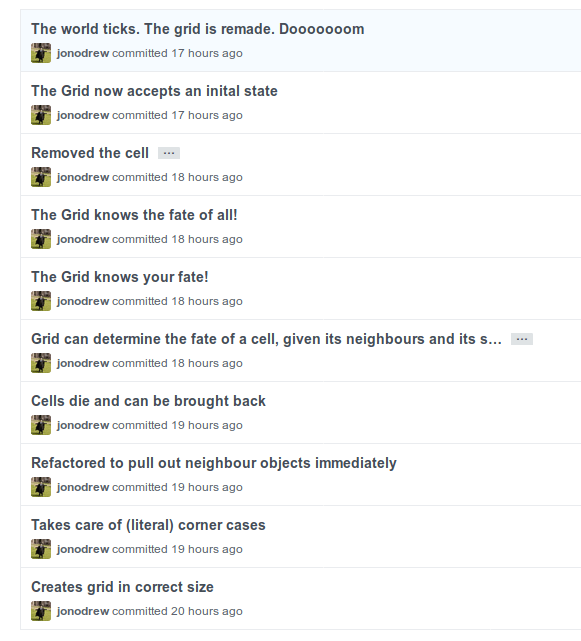
I enjoyed it enormously, and I got a chance to talk about the work we do and evangelise about working with us.¹ In fact I enjoyed it so much that I went home and then came up with a solution to the problem solo, with commit messages that got weirder the later it got:
It was a really interesting reminder of how I originally learned to code, which was by fruitlessly bashing at the keyboard like an unionised monkey in an infinite cage. I had no real clue what I was doing, and when things worked I got a huge rush of endorphins that spurred me on. Intensive sessions like these put me next to people who are in that space, who just want to get on and write code and not hang around waiting for this fuddy-duddy government bloke to explain what they already know.
I think I got a bit more senior without ever realising it.
I think that’s how it happens to everyone.
If you look over the commits, you’ll see a snapshot of what I was thinking at that point in time. I really prefer these long commit histories to ones that are artificially squashed and rewritten — at least as a learning tool. For example, my Cell class started as this:
def black_or_white_square(self): return u"u25A0" if self.alive else u"u25A1"
because along the way I realised the Cell class didn’t have to die. In fact, I could even reduce it entirely to a True or False value and never worry about creating objects at all.
Some people didn’t take this approach. Some had Cells that were very weighty and could calculate their own fate, reducing the need for a world and putting each cell in its own bubble. The huge value from events like these, in my opinion, is being exposed to quite different ways of thinking about a problem.
So now you’ve been exposed to mine. What do you think?
⁰ 24 signed up, so I’m curious to know how that drop-off rate compares to the average ¹ If you’ve got to this blog because you attended, you should check out the jobs we’ve got on offer and the skills we expect you to have as a junior data scientist or a junior software developer
Public digital hero and globetrotter Dan came over to play chess. We tried to talk about things and play a serious game, and found it was like trying to rub your stomach and pat your head at the same time. You can do a shallow version, but try anything more serious and your brains squidges out of your ears. So instead we played a really good game, and then we followed that with a very quick game that was full of exceptionally stupid moves.
There is some kind of lesson in there.
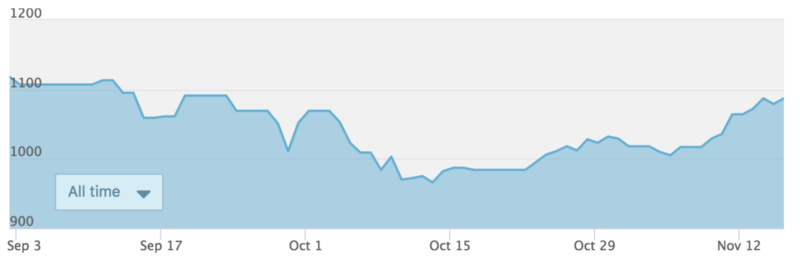
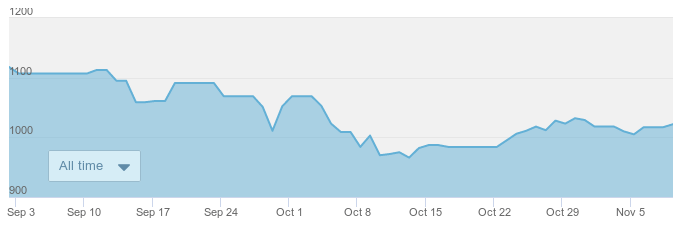
I am getting a little bit better at chess all the time. My rank for daily games is now apparently 1087, which puts me in the 28th percentile on Chess.com. That’s very low, so I’m going to keep plugging away. If you work around me and feel like a game, then let me know because I’d love to play more.
Completely drained
I had various deeply emotional conversations with friends this week. They’re good, but I find myself completely worn out by the end of the week, desperately keen for a bath and some quiet and solitude. Just me, hot water, and the weird gloing-gloing noise that water makes in your ears when your head’s almost under.
On Monday I was at the Foreign Office for a tour. It wasn’t hugely interesting, but then I should have known that beforehand — buildings have always just been buildings to me. On Tuesday I had a free evening so I set up a giant monitor and used it to spur me to finish my book.
No, not really. I played Civilization 5 and may have had a late night. It’s impossible not to just have one more turn on this game.
I also had a meeting cancelled on me; cancelled, in fact, twenty minutes after the meeting had started. That felt very unpleasant, but I’m trying to put a positive spin on it. All the same, I could feel all of that pent up nervous energy before a presentation still trying to escape. So I went for a long walk. It seemed to help. Nonetheless, I think that’s definitely contributed to my feeling of being drained and washed out.
Global Day of Code Retreat
I met more of my colleagues, particularly the ones who do Java. I also met lots of other new people; some people from Makers who were just starting to learn (but were still very impressive), some people who were already well established, and some people who couldn’t code but were very eager to learn. We worked in 40 minute blocks and then deleted all the code that we’d written, which was heart-rending the first time. And the second, actually, and every time after that. What was most interesting was the variety of code I found myself writing, even though the problem stayed the same. I also ate a lot of deep-fried sweet potato fries, and that felt somehow soul-improving.
I also did a tour of our offices, and that was fun because I got to use my ACTING VOICE, which is like my real voice but more confident and willing to do call-and-response.
If I met my acting voice in the real world, I would hate it and be desperately envious of it at the same time.
I also started the morning with a discussion about existentialism and stoicism, because I did a degree that does not pertain to programming except in all the important ways.
It was loads of fun, and re-inspired me to be more test-driven in my developing. I love stuff like this, particularly mentoring, because it reminds how much I enjoy doing it. Sometimes it’s easy to lose sight of the fact that I’ve completely, ridiculously lucked out with this job.
I’m really glad I got nominated for this by Amanda, because I’m on leave this week and so my weeknotes are pretty sparse.
Location: London, at least for the next two or three years. I’d probably swap it for anywhere, as long as the opportunity looked like a challenge. Current Gig: Software developer for the Government Digital Service, which is part of the Cabinet Office Current mobile device: OnePlus 5 Current computer: Work machine is a giant, 15 inch Macbook Pro. It is annoyingly heavy and a pain to cart around. My personal laptop is a lightweight Dell XPS running Ubuntu 18.04 One word that best describes how you work: Calmly
First of all, tell us a little about your background and how you got to where you are today.
I have an undergraduate degree in French Studies, which at first glance doesn’t look like a strong foundation on which to base a career in software development. It is, but it’s not why I’m where I am now. I started to get interested in digital generally while at university, and when I was elected as the Public Relations person for a society I really got stuck into it — building an entire website and logo rebrand from scratch.
They’re still using the logo, but the website was definitely not worth saving. So when I left university I applied for the Civil Service’s Fast Stream programme, specialising in digital and technology. I was successful, and spent the next two years moving around government departments, doing a huge spread of interesting things while also learning to code in my spare time. I wrote software to try to balance a conference I organised, a prototype web service for the Fast Stream programme, and even mentored someone as they built a way for script writers to extract scenes from their teleplays. I saw an opportunity to be a CTO and seized that: I failed a lot but started to get better at managing people, at seeing the wider scope, and at strategic thinking.
In June of 2018 I rejoined the Civil Service, hoping to build up my technical skills and progress further in the organisation.
Take us through a recent workday.
I tend to be up at 0600 and out of the door by 0730. I catch a train to London Bridge and then walk the rest of the way to the office, because that way I at least do some activity and I get to see London glittering and stirring in morning sun. If it’s a Monday, I’ll buy a Big Issue from Sharon, who’s at the south side of London Bridge.
That puts me in the office for about 0815, and I get straight into my inbox and catch up on Slack. I hate Slack. It’s an all-day meeting that you can’t miss, and so once I’m caught up I’m unlikely to look at it again until lunchtime. Ditto my inbox.
I’ll look over any pull requests I’ve been assigned, and start working through the shortest ones first.⁰ Before I know it it’s standup time — an agile ceremony I facilitate. The point of it is to raise blockers, celebrate successes, and reassess work that seems to be dragging. We’re always done in 15 minutes, which means I can get back to my desk and write code for a couple of hours before lunch.
I try to bring my own lunch and find people to eat it with, thereby forcing them to eat lunch and do it away from their desk. I also get positive affirmation from people looking at my lunch and making admiring/jealous noises, which is really all I can ask for.
The afternoon usually has one or two meetings in it — I might attend a show and tell for the programme, I could be mentoring a colleague, or even just grabbing coffee with my manager to get feedback on how I’m doing and where I can improve. I have a brilliant manager, and they’re definitely a big part of why I’m so excited to work where I do.
At 1500 the team takes a pause to fika: we have a cup of tea and a civilised biscuit and chat about non-work stuff. It’s been really effective at bringing us all a bit closer together, but I still can’t not say it in the voice of Pikachu.
By 1630 I’m out of the door and on the way home, walking back towards the centre of town to catch a train home where I can get back to procrastinating instead of writing my book, like I ought to.
What apps, gadgets, or tools can’t you live without?
My phone
My laptop
My pen and a pad of paper
Apps: PyCharm is my software for writing software (how meta!); Twitter is a hellsite but also where many cool people hang out so I use it and try to avoid the nazis. I use Podcast Addict for, well, podcasts, and then on my laptop I’ll use Google Suite avidly. I also use the classic version of budgeting software YNAB, because otherwise I spend money like there’s no tomorrow. Finally, I use the Chess.com chess app to try to get less bad at chess.
So far I have got less good, so there are some questions to be answered there.
Finally, I have the Duolingo app, where I brush up my French and improve my Russian.
What’s your best shortcut or life hack?
Turn off all your notifications. I get notified on my phone if someone in my urgent contacts list calls, and I get notified on my computer if I have a meeting in five minutes.
That’s it.
It makes me a better developer and a significantly more chilled out person. If someone really needs you they’ll come and find you, or they’ll figure the thing out by themselves.
Alongside this: ask the question in the opening. Don’t send a slack message that says:
Hey, how’s it going?
Because then I’ll respond in two hours saying:
Hey, great thanks! You?
And then you’ll ask your question, and you’ve wasted a load of time. Give the question and as much context as you can in the message, and then I can devote my entire brain to it in one go.
If you’re thinking “But Jonathan, if I have to write a long and complex message detailing the context I wouldn’t use Slack, I’d write an email!”:
Yes. Please do that.
Take us through an interesting, unusual, or finicky process you have in place at work.
Here’s how I get my payslips:
I access the guest account on one of four machines specifically kept for this purpose.
I log into the VPN using my ID and password
I open the special link to our HR software
As this is the guest account, I don’t have Lastpass installed, so I need to dig around in my phone to find the password I’ve used for this.
I log in
I view my payslip
I download it as a PDF
I log into my Google Suite account, once again painfully typing in a long and complex password.
I do my second factor approval
I save the payslip into my Google Drive
I log off
I take a long walk, muttering blood curses on the providers of this software to the 14th generation and occasionally screaming
I should point out that it’s getting better. It’s still a righteous pain in the behind, and the worst thing is knowing how much better it could be.
How do you keep track of what you have to do?
Many To Do lists on many Trello cards on many Trello boards
What’s your favourite side project?
The Book, with which I have a love-hate relationship.
What are you currently reading, or what do you recommend?
Just finished Frankenstein in Baghdad
Who else would you like to see answer these questions?
I’d like to see any Deputy Directors or above in my organisation answer these, as I’m interested to see how it differs. Oh, and Jenny Vass.
What’s the best advice you’ve ever received?
“Don’t stand there, mouth agape, waiting for your turn to speak. Listen. Hear me. Understand the depth and experience and history behind these words, because what I’m saying isn’t filler in the film of your life before the monologue that wows the crowd. It’s worth a damn. Act like it.”
⁰ A pull request is a way for someone to add code to your or your team’s repository. They write the code they think should be added, and then notify you that they’d like to add it. You run through it and generally give feedback, and they iterate it until you’re happy. It’s a process that is completely fraught with social anxiety, but it’s also the best way we’ve got to ensure code consistency. Here’s an example of my team giving excellent feedback on one of my pull requests.
I had an interview this week for a place on our internal development scheme for senior managers, because that’s what I am.⁰ I’m really excited to find out how it went, which is bad news for me — because I’m not going to find out until mid-December.¹
At the same time, I’ve managed to seize an hour of time with the senior person I need to talk to about the Project, but that won’t be until the week after next. If nothing else, it’ll be good to get feedback on whether the swardley map I put in has had the desired outcome.²
Oh, but at least I’ve got code to write. That’s a genuine pleasure, and even more so now that I’ve collected a mentee who wants to learn. She’s working on a project that’s enormously close to my heart, and it’s an opportunity for me to teach what I love. It’s a complex, interesting problem and coding is itself a weird quasi-art form, so there’s going to be plenty of challenge.
Before one codes, of course, one has to install a bazillion libraries.³
Cookie monster drumming its fingers on the table
This week has been a very good, very gentle kind of week. Wednesday was the most meeting-heavy week, but at least an hour of that was because I went to One Team Gov breakfast. I’ve been plugging away at a new GDPR-flavoured feature and it’s a doozy, but I’ve finally mostly finished. I got some really great feedback and a chance to pair with my senior on it, so all in all it’s been a really good week.
Hum. That feels a bit dull really. This weekend I was at Open Data Camp which was at my old university, so I went on a massive illustrated trip down memory lane. It starts here, if you’d like to read more:
I'm up, eaten and ready to roll, so I'm heading up to the university to see what's changed. The sun has well and truly beaten me up though, so good morning to you, sun.
The university’s representative is an old friend of mine, and I’ve volunteered myself to come up and talk to students about the importance of squishy human-ness to software development.
I also appear to have volunteered myself, over the course of the day, to give a TED talk on topographical intelligence. I was not expecting the weekend to go like this, but go like this it has and go with it I shall.
There you go, if someone wants a TED / TEDx speaker on mapping – we have a volunteer -> https://t.co/GpITj7evhh
That — alongside some very nice compliments⁴ from people who found themselves in an impromptu mapping session with me — has kicked me into writing more of the Book, along with thinking about how I’d present it as a talk without just nicking all swardley’s slides and regurgitating his keynote from Google and oh god what have I got myself in for.⁵
After a day like that everyone else went and extroverted⁶ in the pub, but I couldn’t bear to do any more talking so headed back to my hotel for a steak and an evening of writing. And here’s its culmination.
How incredibly meta that is.
⁰ An accident, I assure you, but a happy one ¹ Cue the finger twiddling. ² Still, it’s a while away. Back to the twiddling. ³ Wow, these fingers are going to be twiddling champs before much longer. ⁴ “I‘ve never seen anyone but Simon present it with such a focus” ⁵ I’ve just fear-written a thousand words, although the swearing is probably going to have to come out ⁶ and bled, poor Jamie!
A little while ago — a time that feels at once sharply present and mistily distant — my partner and I broke up. I’ve been commenting on Twitter since then that the director of my life has gone into full hack overdrive. Your hero walked out of his office to see that ex’s name plastered on the side of a bus, for example. Anyone watching this in the cinema would roll their eyes at the heavy-handedness of the symbolism.
We had a comfortable life, they and I. We had a cat. We had good jobs in similar industries. We were complimentary, and we were complementary. Something changed though: they were thinking about settling down; about the prospect of children; about roots.
I can’t stand the idea. I’m not interested in children, and I don’t think it would be a good thing for someone who isn’t interested in having children to have them. I don’t want that much commitment: I like being able to upend my life. I want to move to Canada for a little while, and maybe live in Europe again. So that was that.
It’s funny, though. Because now they’ve not got a partner, they’ve taken a job that could involve a lot of international travel and will propel them upwards. And me? I’ve started learning their mother tongue with a more serious bent than I ever did when we were together, and I’m interviewing for ever more senior things. We’re —honestly, you’ll laugh — we’re more attractive to each other now than ever before.
Isn’t that funny? Together, what we want is incompatible. Apart, we’re precisely what the other wants.
This week began really well, with a houseparty. It looks like it’s going to be finishing well too. There was a good bit in the middle too. All in all, a bit chuffed. Theme of the week: French
Onwards!
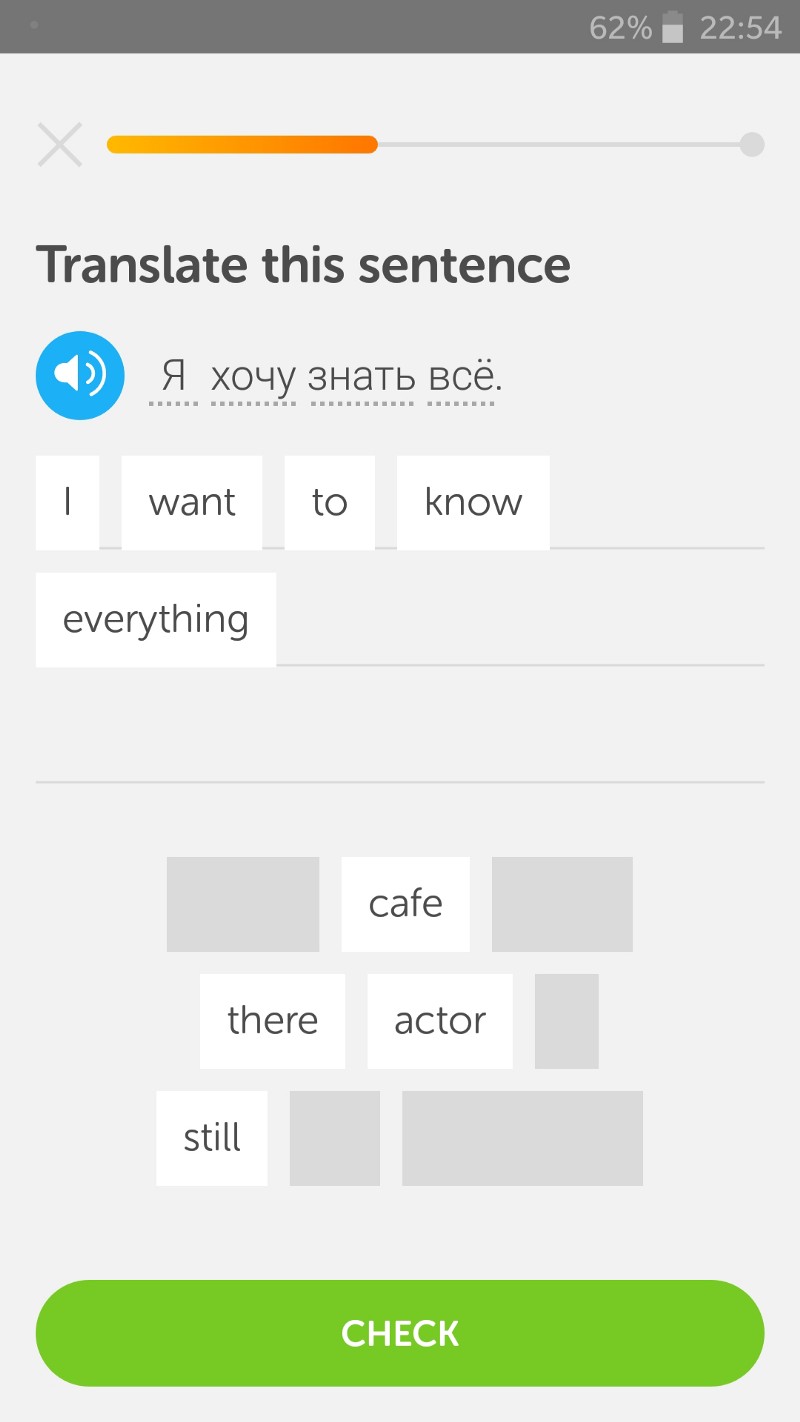
1 Thème de la semaine : On Tuesday I attended my first ever French meetup, and some very nice people told me I had a good French accent. This made me Very Happy, and I strongly suspect influenced my next morning, where I collared Jenny and we talked about existentialism⁰ before I went home feeling grotty. French studies was my undergraduate degree, and I love to speak it. Mind you, I’ve been told before that I’m a different and less pleasant person in French, so I was watching that too. I met some interesting and some less interesting people, but it was a lovely evening and I think I’ll make it a regular fixture. I’ve also been invited to a recurring French lunch of civil servants, so before long I hope to be quite fluent again. I’m improving my Russian at the same time too:
A screenshot that says “I want to know everything” in Russian and English
2 Career things. I went for an interview the other day and I didn’t get the job. I’m okay with that, because the feedback was detailed and immensely valuable as I head into my Future Leaders Scheme interview (link only available to civil servants). I also spoke to a Director about where I’d like to end up and he gave me some really good advice as well as a really interesting comparison — at a large consultancy firm, there are 23 promotions between my equivalent level and boss of the organisation. In my organisation, I’d only need five to get to the same place , which means within those levels there’s going to be huge variation. It makes me feel weirdly better — friends from uni who seem to get promotions every couple of years are actually probably just progressing at the same rate as me. They just get more frequent milestones.¹
Work is otherwise very good. I implemented fika and work-in-progress limits to try to get the team to slow down and do one thing at a time. Both have been moderately successful: we are shipping things and doing it faster, and we are communicating more as a team and learning things about each other. Some of that introduces tension, because there’s always a risk when you get to know someone that they’re going to be quite different from you in a way you weren’t expecting.²
3 I’ve already started to think about my goals for the next year. This is because I like things to aim for. By September next year I am aiming to:
have a basic conversational level of Russian
have a rank greater than 1200 in both daily (24 hours per move) and rapid (30 minutes per game for each player) chess
have a first cut of The Book, which has admittedly slid³ a little recently
be (re)starting an MSc
None of these are work things, but I think they’ll make me better at work. I have a number of thoughts like this, so if you’ve got £2.3m and would like to know more about experiments I want to do on my colleagues then get in touch.
4 Time tracking is turning up some interesting results. Inspired by fellow public sector digital hero Dan Barrett I’ve been tracking my time. It’s broad strokes, but here is the approximate time I spent in meetings this week:
A chart showing that on Monday I spent 1hr 35 in meetings, on Tuesday 1hr 51, on Wednesday no time at all, on Thursday 3hr 27 and Friday 15m
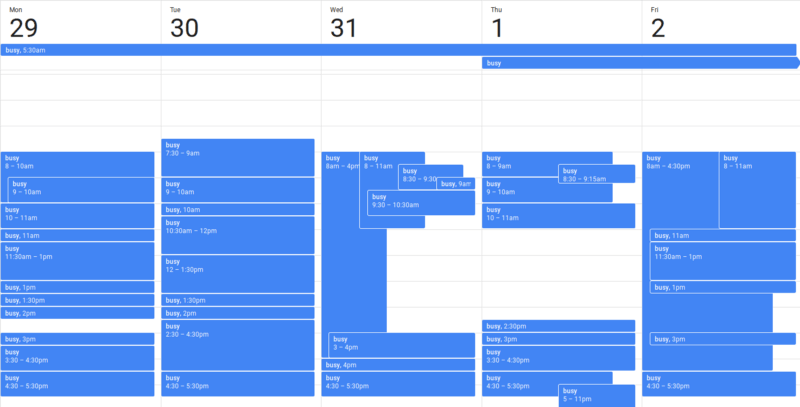
Thursday is the outlier, and also the day I came home absolutely wiped and ate an entire blackcurrant crumble.⁴ More than half of my day spent in meetings is too much, and that’s valuable information for me. It’s also deeply concerning, because — well, here’s my friendly deputy-director’s diary:
A screenshot of a diary. There are only 11.5 hours out of 47.5 in that week that don’t have something booked
Now, this is only one week. I need more data to be able to make a more accurate view, but my hypothesis is that anything above about 40% completely exhausts me. It’s also true that I don’t know the ins and outs of this DD’s diary — maybe each slot there represents a unique piece of work, and not a meeting.
5 I listened to a brilliant podcast — BBC Radio 5 presenter Nihal Arthanayake spoke to six people from the three security and intelligence agencies⁵. They were five women and a gay man. There are three reasons this was brilliant:
That sentence would have been completely ridiculous fifty years ago, and I’m so pleased that I can write it now
MI6 is apparently the Slytherin of the SIAs⁶
When GCHQ had a big win they played mini golf in the doughnut, and that is so hilariously human that imagining it is making me laugh and laugh
This weekend I bought chocolate, marshmallows, and squirty cream having been inspired by this excellent looking recipe.
⁰ I talk about existentialism a lot, because it resonates quite strongly with me. You can read a thing I wrote, or watch this good video from the US-ian PBS, or listen to this episode from the BBC if you’d like to know more about it. Someone who read my thing said they liked it on twitter dot com, and as a writer that made birds appear and trumpets sound and, look, I don’t want to tell you what to do but if you enjoyed reading something and you tell the author you’ll make a friend for life so… ¹ slash pay rises ² cf. dating ³ I have never been more convinced that slid is not a word than right now ⁴ hashtag no regrets ⁵ MI5, MI6, and GCHQ ⁶ GCHQ, by the way, definitely all Hufflepuffs
A response to a question posed at the One Team Gov London breakfast
Someone posed this question at our OTG breakfast, and it’s been stewing in my brain since. I had a lovely walk this morning with Morgan and it’s helped to frame and restructure my thinking, and now I’ve got an answer.
I cannot make bricks without clay!
I’d use a budget of that size to start running experiments. Proper experiments, with control groups and academic rigour and results published in journals. And then I’d use that data to make a case for wider change. Here’s a few examples:
Summer hours: what if, for six months of the year, we paid people the same amount for four days as we would normally pay them for five? The ethical implications of this are large — how do we select the team that gets a day off? Is it fair?⁰
Does non-work related development improve productivity? I’m imagining giving one team of people £1,000 per year per person to spend on developing themselves in any way they wanted, another team £1,000 per year per person to spend on approved, work-related training, and another group nothing at all.
Incentive lottery: we’re in the midst of our annual People Survey. It’s hard to get people to fill it in, so what if we said: for every person who fills it in, we will put £50 into a pot and enter that person into a lottery. Then, after the deadline, we’ll randomly select 10% of the entrants and split the entire pot between them. Would it incentivise people? Or would the one person who really cares get rich?¹
I think a culture of experimentation, in an organisation like ours, would be a cool thing to build. So: who’s got £2.3m going spare…?
⁰ The answer is probably “No, but we might learn something valuable” ¹ Caring is a superpower though, so maybe that’s a good thing
Unless you get meaning when you’re born, in which case I got missed out
I am having an existential crisis. Some people have said that we all are; that we’re going through an exotic sprism of wondering what the purpose of everything truly is. We’re reaching for easy answers, and certain people are happy to offer them. Maybe I’m one of them. Let’s see.
Existi-what now?
First — briefly — existentialism.⁰ Suppose that there is no moral law in the universe. There’s no God and no Hell and prophets are just (always) men. When you die, you simply won’t be. You know that place you go to when you’re asleep? That’s where you’ll go forever.¹ The law is not a moral guideline: people have done² terrible things to other people entirely legally.
If that’s true, then we are suddenly, horribly, startlingly alone — not alone before a judge, or the pearly gates, or in prison. Just alone. Nobody can tell you what is a good thing to do. Only you can tell yourself that.
The agony of choice
We are condemned to be free — Jean Paul Sartre, Existentialism is a Humanism
Well, that’s bleak. It’s the anguish at the centre of being: all the time, you have to make a choice. You have to keep making choices forever, until you die. That’s an option too, by the way. In fact, Camus said the only real question in philosophy was:
Should I kill myself, or have a cup of coffee?
The point is that you’ve still got to choose. Unless you don’t: there are other structures out there for meaning. Religion, social justice, ethno-nationalism, the hustle, visiting every tube station in the world. If some of those seem absurd to you, you’re right. All of it’s absurd. Some of them are shitty, and if you find meaning in ethno-nationalism you’re going to find there are plenty of people who find meaning in opposing you.
As long as you’ve chosen it, then you are at least living in good faith by seeking meaning for yourself. Living according to someone else’s morals is bad faith, because then your essence is predicated on someone else’s existence. That’s not healthy. What if they turn out to be a milkshake duck?
Meanings! Get your meanings here!
People do, of course. We all do. I do. I go to work and I work hard and I write code and I do my job, and I do it every day, and I’m starting to wonder if this was a choice I made or one that was made for me and I never noticed.⁴ Hence: existential crisis. Am I living in bad faith?
Now: some people disagree with the foundation of this. Sartre says that existence precedes essence: that you are born, and then you become. But don’t we all have some essence? Something that governs how we’d act, what we would do, given the same situation?
I don’t know. I don’t think so.
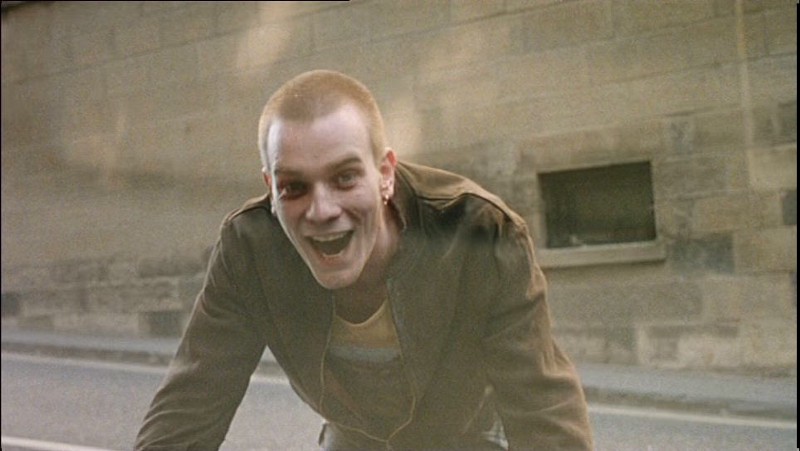
Anyway. I’ve wildly overused both my brain and the word “choose”, so here it is again multiple times. Enjoy this, from Trainspotting, while I go and drink tea and play with the cat. It’s an absurd way to pass the time — but then, of course, so is everything else.
Choose life. Choose a job. Choose a career. Choose a family. Choose a fucking big television Choose washing machines, cars, Compact disc players, and electrical tin openers. Choose good health, low cholesterol, and dental insurance. Choose fixed-interest mortgage repayments. Choose a starter home. Choose your friends. Choose leisure wear and matching luggage. Choose a three piece suite on hire purchase in a range of fucking fabrics. Choose DIY and wondering who you are on a Sunday morning. Choose sitting on that couch watching mind-numbing spirit-crushing game shows Stuffing fucking junk food into your mouth. Choose rotting away at the end of it all, Pishing your last in a miserable home Nothing more than an embarrassment to the selfish, fucked-up brats you have spawned to replace yourself. Choose your future. Choose life
⁰ As brief as I am capable of being. ¹ Hey, does that mean every time you fall asleep you die? ² And still do ³ In the case of the more extroverted preachers, literally yelled at you ⁴ There is a danger with this stuff that it sounds like self-help aimed at other, equally privileged people like me. I would like to avoid that. Some choices are bad both ways, and people with more privilege will likely have fewer of those. I don’t think there’s a requirement to be happy with your choice, and I also know that’s little comfort. Sorry.








 Caffeinated Punctuation